
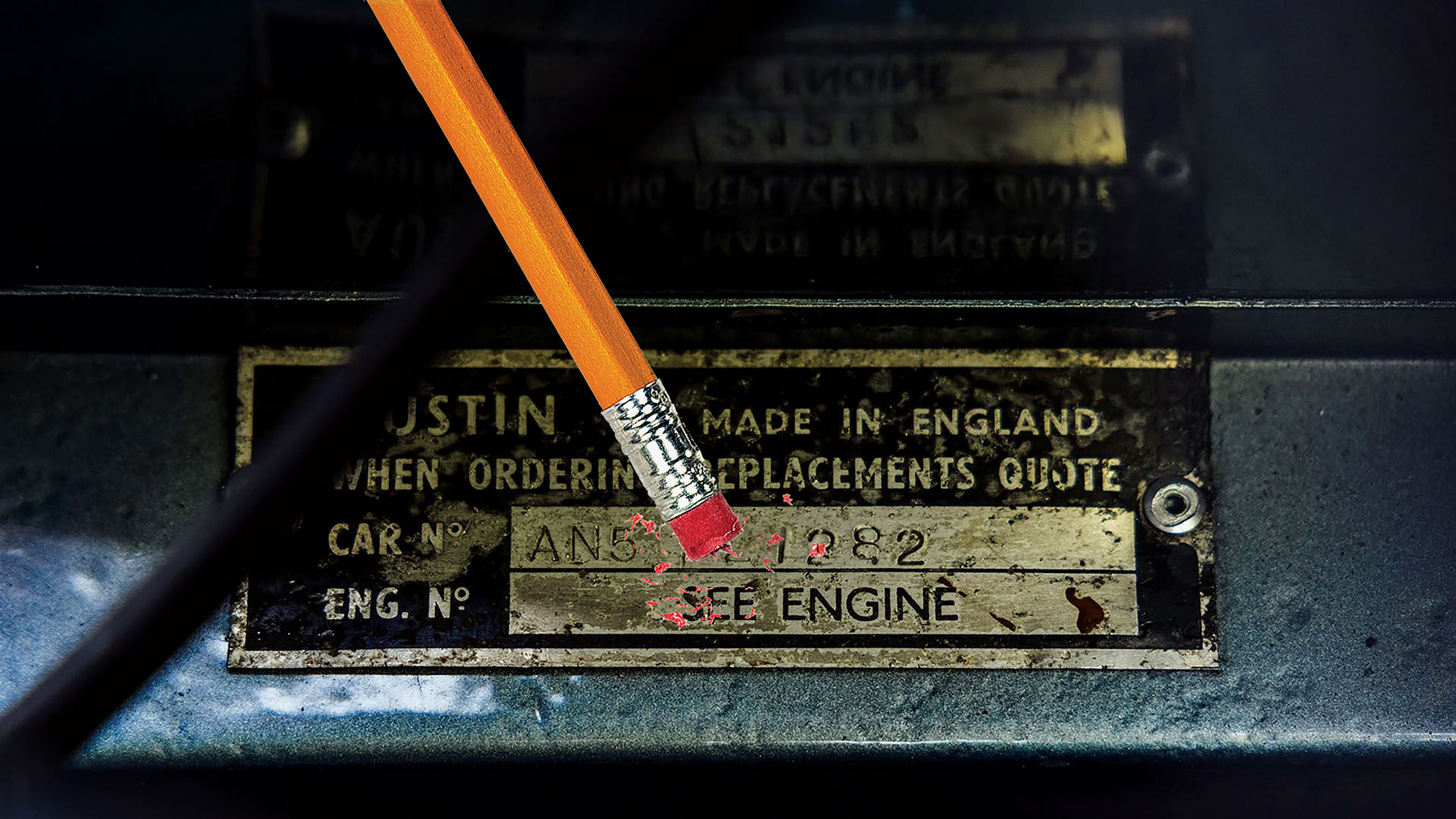

I recently received a call from “Charles,” who allowed me to share his story. He is the happy owner of an Austin-Healey he purchased several years ago from a California resident. The seller’s family had owned the car for many decades, and the car had spent 40 years in storage. Charles knew he had purchased a fixer-upper — as all barn finds are — and put a lot of money and effort into making it a better car. He has now reached the point where he wants to get the title straightened out. The problem is that the title shows the […]
I recently received a call from “Charles,” who allowed me to share his story. He is the happy owner of an Austin-Healey he purchased several years ago from a California resident. The seller’s family had owned the car for many decades, and the car had spent 40 years in storage. Charles knew he had purchased a fixer-upper — as all barn finds are — and put a lot of money and effort into making it a better car. He has now reached the point where he wants to get the title straightened out.
The problem is that the title shows the Healey’s engine number as its vehicle identification number, or VIN. This is a common situation with older cars. Back in the day, manufacturers assigned chassis numbers to their cars, which would sometimes disappear or become unreadable. Often, owners and licensing agencies would just use an easy-to-locate engine number, and that would be perpetuated from title transfer to title transfer.
An easy fix?
The quick answer is that this should not be a problem. Charles could simply take the car to his local DMV and have the title error corrected. DMV would inspect the car and see that the title corresponded to the engine number instead of the number on the chassis plate. It would recognize this as a common circumstance with older cars and reissue the title with the chassis number as the VIN.
Unfortunately, that does not work for Charles, as there is no chassis plate on his car. A missing chassis plate usually raises questions about whether the car was stolen, but Charles assured me that there was no possibility of that. The seller had a replacement chassis plate created for the car but had never installed it. He gave that to Charles when he sold him the car, but Charles had been worried about installing it for fear of doing something illegal.
Replacement chassis plate
Swapping out a car’s chassis plate can be an edgy thing. Thieves do it to hide the identity of a stolen car. Counterfeiters do it to misrepresent the identity of a fake car. Thus it’s easy to fear that in doing so, you might be in the wrong. But in this case, I didn’t think there was a problem. Chassis plates do get lost over time. Rivets rust away, cars get repaired or restored, or the numbers become unreadable due to age and corrosion. Replacing a chassis plate with another is okay if you’re keeping everything the same and you aren’t falsifying anything.
However, that wouldn’t work for Charles either, as the replacement chassis plate the previous owner gave him used the engine number as the chassis number.
That’s not ideal, but at least the title, chassis plate and engine number would all match, which might be the best he could do in this case.
No numbers
But that wouldn’t work for Charles either, as that engine has since been replaced, so the number on the title no longer matches the engine that’s in the car. Now we’ve gotten to the real issue.
Charles explained that Healeys have body numbers stamped in seven places around the car. He looked at all seven and found the same body number in six places. That pretty much confirmed the car’s original body number. Austin Healey factory records correlate body numbers with chassis numbers, which allowed Charles to discern the original chassis number of his car. He ran that number through the National Motor Vehicle Title Information System database, and it did not pop up as ever having been reported stolen or destroyed.
The NMVTIS is an electronic system created by the U.S. Department of Justice that allows consumers to find information on a vehicle’s title and, in many cases, historical theft data. Federal law requires insurance carriers, auto recyclers, junk yards and salvage yards to report specified information about vehicles to NMVTIS.
While you can’t run an NMVTIS search yourself, its website will point you to several authorized companies that can provide a vehicle history report for you at a reasonable cost. You simply input the VIN, or in some cases the license number, and the system downloads a report.
You can also run a free VIN check on the National Insurance Crime Bureau website. NICB is sponsored by the insurance industry, and its searches will give you a title history, title-branding information, and whether the vehicle was reported as stolen, salvaged or considered totaled after an accident.
No authentication
So, Charles has confirmed the original chassis number of his Healey, and that it has never been reported as stolen or destroyed. What he really wants to do is get the car’s title corrected to reflect that original chassis number. He reasons that he can establish that using the factory records so DMV will know he isn’t pulling a fast one.
Getting it to issue a new title, however, isn’t going to be a simple task. The easiest thing would be to create a new replacement chassis plate with the correct chassis number on it. However, Charles doesn’t think it would be possible to get a replacement chassis plate today, and he worries that a brand-new chassis plate would stand out like a sore thumb.
Even if he did manage to create one, the car would present with a chassis number that is totally different from the chassis number shown in the current title. That can’t be easily explained since the engine with the corresponding number is long gone. DMV is more likely to resolve the matter by issuing an assigned VIN to the car, which is colloquially referred to as “blue tagging” the car. When DMV assigns a VIN to a car, it will permanently affix a tag to the car (which typically used to be blue), showing the assigned VIN.
There is no way Charles is going to persuade DMV to assign the original chassis number to the Healey. That is something only the manufacturer would do. Old chassis numbers don’t conform to current numbering practices — this isn’t like ordering a custom license plate. Moreover, DMV isn’t going to look at factory records and decipher them to identify an original chassis number. It really doesn’t care about the authenticity of the car. It just wants to know that this car carries a unique identifying number to differentiate it from all others, and its assigned number is plenty good for that purpose.
Imperfect world
Charles doesn’t like the blue-tag solution because he thinks it would detract from the collector value of the Healey. There is certainly some truth to that. Any potential buyer seeing a blue tag is going to naturally wonder about the identity and authenticity of his Healey. After all, the blue tag is there because there was a problem with identifying exactly what this car really is.
To ameliorate that problem, Charles does have the body numbers on the car and the factory records to establish the original chassis number. He can prove to the buyer exactly what the car really is. Will that be good enough?
Maybe not 100%, but it has to be better than what he has now. The body numbers and the factory records do establish the true identity of the car, but the car has no chassis plate and a title that shows a VIN that cannot be traced to anything on the car. That seems like a much messier situation than the blue-tag VIN.
The larger point to be made here is that collector cars, by their nature, are really just old cars. No manufacturer ever expected its cars to have enduring investment value when they were being built. They were all intended to be used, worn out and discarded — and hopefully replaced with a newer model. It is the rare car that today has all the same components as it did when it left the factory. That means that the overwhelming majority of old cars will have authenticity issues. There is, of course, a compelling financial incentive to “correct” that, but our realistic ability to do so is often extremely limited.