
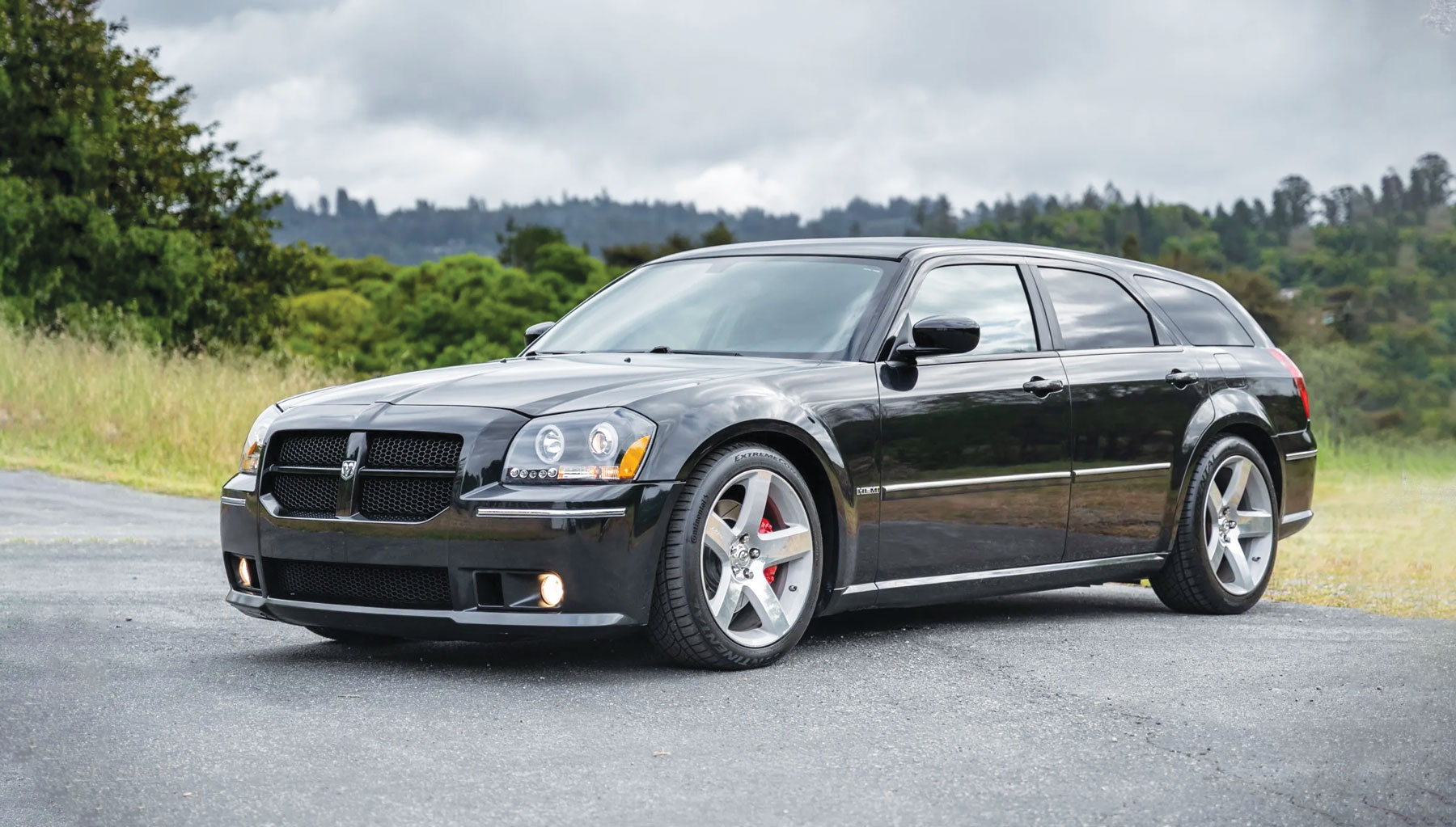

2008 Dodge Magnum SRT8 – photo courtesy Bring a Trailer Dodge’s oft-forgotten Magnum SRT8 is a performance-wagon bargain The legacy of DaimlerChrysler’s “marriage of equals” shall be debated by automotive historians for years to come. But there was at least one fruitful result from this period, so long as a slammed, hot-rod station wagon is your cup of tea. Der muskelwagen If Chrysler’s pivot from front-wheel-drive sedans to the rear-drive LX platform in 2005 was surprising, Dodge’s decision to first use that architecture to launch a low-slung station wagon (er, sorry; sports tourer) in an SUV-infatuated market was even more so. […]
2008 Dodge Magnum SRT8 – photo courtesy Bring a Trailer
Dodge’s oft-forgotten Magnum SRT8 is a performance-wagon bargain
The legacy of DaimlerChrysler’s “marriage of equals” shall be debated by automotive historians for years to come. But there was at least one fruitful result from this period, so long as a slammed, hot-rod station wagon is your cup of tea.
Der muskelwagen
If Chrysler’s pivot from front-wheel-drive sedans to the rear-drive LX platform in 2005 was surprising, Dodge’s decision to first use that architecture to launch a low-slung station wagon (er, sorry; sports tourer) in an SUV-infatuated market was even more so. The Dodge Magnum was visually distinctive — thanks to its broad shoulders and sloping roofline — but also versatile, with a cargo space that expanded to nearly 72 cubic feet with the rear seats folded flat. Like its 300 and Charger sedan siblings, Magnum was soon given the full performance workup by Chrysler’s Street and Racing Technology (SRT) engineering group, culminating in the Magnum SRT8, which debuted at the 2005 Los Angeles auto show.
While lesser LX cars offered a 340-hp 5.7-liter Hemi V8, a new 6.1-liter variant was drummed up expressly for SRT8 duty. It benefited from both additional displacement and a treasure-trove of go-fast goodies, including high-flow cylinder heads, short intake manifold runners, individual exhaust headers, billet high-lift cams, flat-top pistons connected to forged con-rods with floating wrist pins, and piston oil squirters. This larger engine also had a 10.3:1 compression ratio, allowing it to crank out 425 hp at 6,000 rpm and 420 lb-ft of torque at 4,800 rpm. Despite this all-American powerplant, power was sent to the rear wheels through a 5-speed automatic transmission developed by Daimler-Benz.
SRT’s efforts weren’t limited to the engine bay. Magnums already used a short- and long-arm front-suspension design, along with a five-link independent rear suspension and subframe that was effectively cribbed from the W211-series Mercedes-Benz E-Class. SRT8 models gained thicker sway bars, increased spring rates, Bilstein dampers and four-piston front and rear brake calipers from Brembo. Magnum SRT8s also rode a half-inch lower than their standard counterparts, a stance only accentuated by massive 20-inch forged alloy wheels, wrapped in sticky Goodyear F1 performance tires.
Other SRT8-specific touches included a unique front fascia with brake-cooling ducts and plush, heavily-bolstered front bucket seats. Only three color choices — red, black and silver — were available at launch; blue joined the palette for 2008.
Big power, low sales
Unsurprisingly, wagon-loving, lead-footed automotive editors within enthusiast media circles praised the Magnum SRT8, commending both its outright performance and sub-$40,000 price tag. This, despite issuing some gripes over harsh gear changes and some questionable interior trim materials. Period testing validated Dodge’s original performance estimates, which called for 0–60 mph to pass in roughly 5 seconds, while ripping through the quarter-mile trap in the low 13-second neighborhood. That’s still considered quick even 20 years later.
Despite the Magnum’s portly 4,300-pound curb weight, the SRT8 managed to be surprisingly agile and planted for its size. Interestingly, Motor Trend pitted the SRT8 against its Germanic cousin — Mercedes’ E55 AMG Touring — and found the Dodge had an edge on both the 600-foot slalom course and on the skid pad, where it pulled a neck-wringing 0.90 g during testing.
Alas, strong track performance doesn’t equate to a showroom sensation. Between 2005 and 2008, Dodge moved just under 170,000 Magnums, with SRT8 models accounting for less than 3% of that total, meaning it was outsold by other SRT-tuned LX cars by a margin of four to one. After building 239 examples of the facelifted 2008 Magnum SRT8, Dodge’s muscle wagon was officially put out to pasture.
Brawn, beneath the radar
“Twenty or 30 years from now,” MotorTrend wrote, “enthusiasts will remember the wagon with the optional monster motor that somehow got past the corporate bean counters … this will be a collectible car.” Prescient words, but Magnum SRT8 values have yet to rise accordingly, especially in the context of similar modern muscle wagons.
Driver-grade, #3 condition Magnum SRT8s frequently change hands in the $20k–$26k range, while spiffier examples could push that window slightly north. Unsurprisingly, lower-mileage examples or those with extensive service records may prove more desirable, but they’ll still sting the wallet less than the likes of the E55 AMG and later E63 AMG wagons, to say nothing of the 2011–14 Cadillac CTS-V wagon.
Magnum SRT8s left the factory fairly well equipped, limiting options to a sunroof, heated seats, navigation and an upgraded Kicker audio system. Apart from the sunroof, none of these features are impossible to retrofit (or even improve upon), so don’t let their absence become a deal-breaker on an otherwise desirable example.
Dodge a bullet
Like all performance machines of a certain age, it’s almost a necessity to find an example with documented proof of regular maintenance, especially when it comes to oil changes. Some owners report the 6.1 consumes a little, especially when pushed hard, so if you plan on regularly tracking or pushing a Magnum SRT8 to its limits, ensure that a quick dipstick check is part of your routine.
Unlike its 5.7-liter cousin, the SRT-spec 6.1 Hemi does without cylinder deactivation and therefore avoids many issues associated with that system. The infamous “Hemi Tick” — where a valve lifter fails and grinds against camshaft lobes — appears less frequently on SRT8 cars but still isn’t an impossibility, especially on poorly maintained, higher-mileage examples. Fortified, improved lifters are available in the aftermarket, but replacement requires pulling the cylinder heads, a tricky task within the confines of the Magnum’s engine bay.
The LX platform’s longevity on the market should equate to a decent supply of mechanical service parts for some time yet, along with performance upgrades that can swap in relatively easily. We’d consider springing for a limited-slip differential, which was added to all SRT8 cars just one year after the Magnum’s demise. That said, given the Magnum SRT8 is a fairly uncommon commodity, model-specific body panels and replacement trim may be trickier to source as time marches on.
With just over 4,100 Magnum SRT8s built, we can’t imagine values getting any lower than they already are, so buy a good example and reap the rewards.
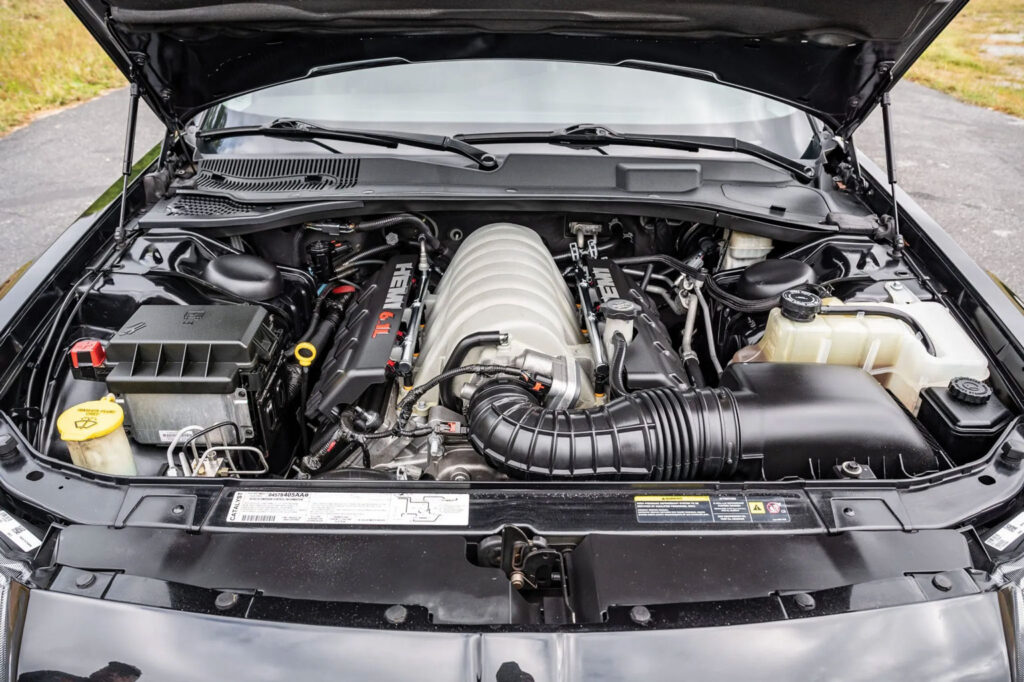
Photo courtesy Bring a Trailer
Leave a Reply