

I was just settling into my favorite of the 3,000 seats in Portland’s Keller Auditorium. I prefer row N, seat 8, as I am close enough to see the facial expressions of the performers yet far enough back to take in overall staging of the ballet. It was Oregon Ballet Theatre’s production of “The Sleeping Beauty” I had come to see. This was its first performance as produced by the company’s new artistic director, Dani Rowe, who arrived last year. She had a long career dancing with the Australian Ballet, Houston Ballet and Nederlands Dans Theater, before spending a decade as a […]
I was just settling into my favorite of the 3,000 seats in Portland’s Keller Auditorium. I prefer row N, seat 8, as I am close enough to see the facial expressions of the performers yet far enough back to take in overall staging of the ballet.
It was Oregon Ballet Theatre’s production of “The Sleeping Beauty” I had come to see. This was its first performance as produced by the company’s new artistic director, Dani Rowe, who arrived last year. She had a long career dancing with the Australian Ballet, Houston Ballet and Nederlands Dans Theater, before spending a decade as a choreographer and artistic director in San Francisco.
I looked at the program (of course, enjoying the feeling of having actual printed material in my hands) and saw the following by Rowe:
“Here we are at one of ballet’s great summits. ‘The Sleeping Beauty’ is often called the Everest for ballerinas…
This ballet establishes refinement, fearlessness and an uncompromising clarity of technique. There is nowhere to hide. It’s the purity that gets you. Every detail is exposed.”
The orchestra had not yet started to play Tchaikovsky’s majestic overture when an errant car-related thought snuck into my head.
If one of the great classical ballets could be referred to as the Everest of ballets, is it such a stretch to refer to Pebble Beach as the Everest of concours?
Stripped naked
Just as the finest examples of excellence in design are chosen for the lawn at Pebble, so are the finest dancers available selected for each performance of “Beauty.” A classic ballet is generally restaged to be true to the style of the original; in this case, Marius Petipa’s 1890 production. With collector cars, an aesthetically perfect restoration reflects all of the inspiration and artistry of the original coachbuilders and technicians involved.
Unlike cars, where restorers often try to emulate the original shapes and styles of when the car was first unveiled to the public, with authenticity and correctness being key points, the choreography of a ballet evolves along with the skills of the dancers, and the zeitgeist of the times.
As I mused on this analogy, it struck me that the “naked” stage design actually resembles the green at Pebble, with nothing but the shapes of the cars displayed against the magnificent backdrop of the Pacific Ocean. No props or artifacts to distract, each car is on display, one against the other. We often see classic cars photographed in fabulous settings, next to iconic architecture and surrounded by glamorous models. However, on the day of the concours, the cars stand alone on the field, each saying, “Look at me, look at me,” sotto voce as you walk by.
Imagine, if you will, 200 of the finest dancers in the world on a revolving stage of enormous size. And as it turns past the audience, each dancer, pair or group performs the choreography they are best known for. That’s analogous to the moment the judges at Pebble ask each owner to start their car and move it on the field.
Of course, for true pyrotechnics there is the Tour d’Elegance, where participants (many behind the wheel of cars now approaching 100 years old) drive a 70-mile course along California Highway 1. Those cars that successfully complete it are recognized by the judges in their scoring. It’s not unlike the huge flurry of activity and controlled chaoes that goes on backstage just before the curtain goes up on a peformance.
Greatness celebrated
A concours has a variety of awards recognizing various forms of excellence, which ultimately culminates in the highly coveted “Best in Show.” This means there will always be a difference between an artistic performance that we hope leads to many curtain calls, as opposed to such a trophy-driven awards ceremony.
In my various years around dance rehearsals and auto restorations, I have had the opportunity to visit shops around the world, and see artists take a piece of bare metal and form it to reveal the shape within.
In a similar way, I once had the chance to take a master class at The Juilliard School taught by Maestro Héctor Zaraspe, with Rudolf Nureyev as one of the students. Just as panel-beaters released the magic from inside the metal, watching Nureyev go from the smallest movements at the barre to the adagio center floor to the grand movements across the entire room was like seeing him release his own personal magic over the course of 90 minutes. He was as focused on achieving his captivating performance as any Alfa Romeo mechanic was on giving a final tune to an 8C 2300 that had once raced in the Mille Miglia. In both cases it was history coming to life.
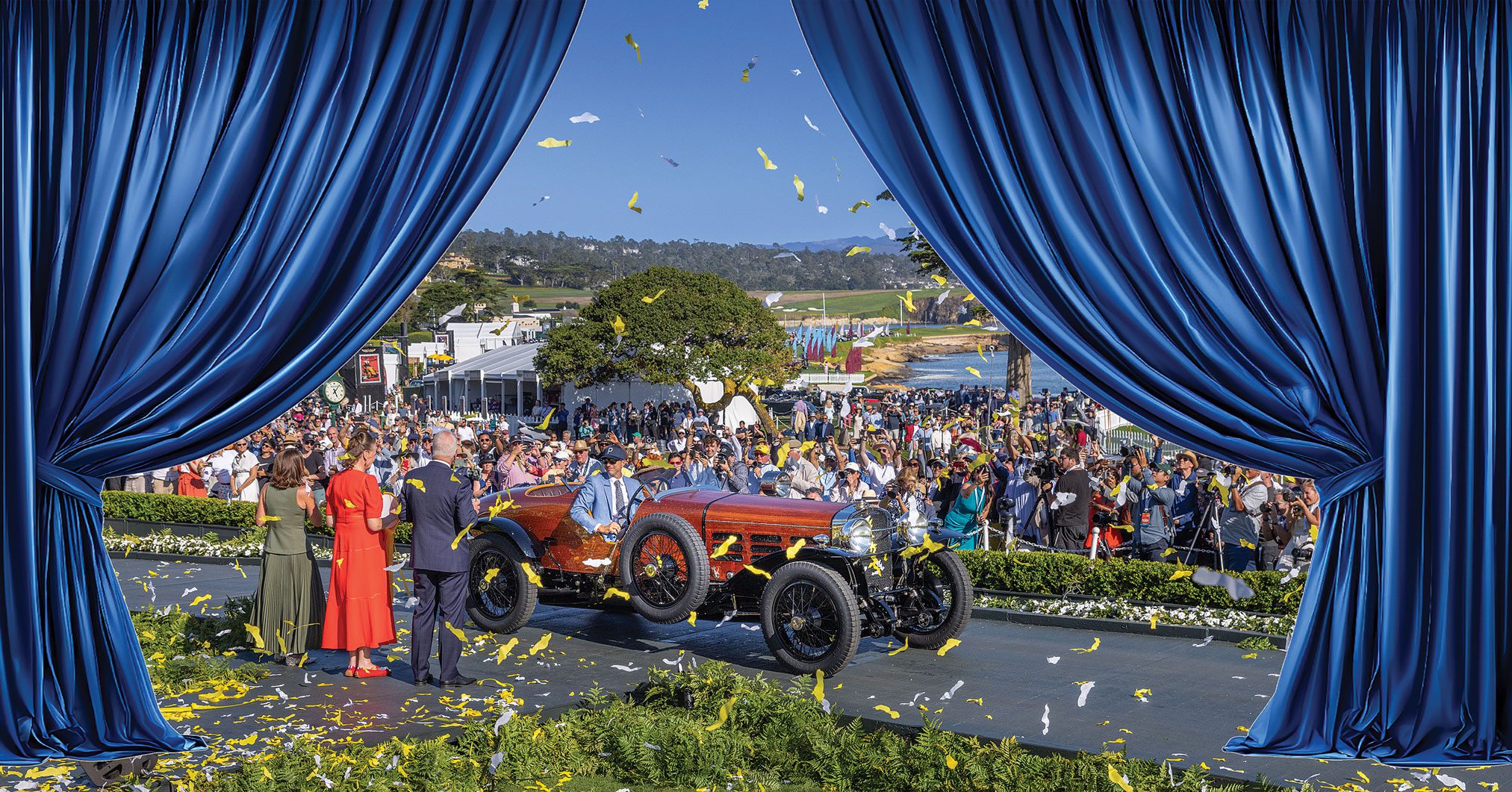
That night’s brilliant performance of “The Sleeping Beauty” and the 2025 Pebble Beach Best in Show-winning 1924 Hispano Suiza H6C represent summits, each conquered in different ways. Both represent excellence of the highest fashion, whether bodies moving through space or exquisite machines barking as they come to life.
As I allowed myself to become more immersed in the ballet, I realized that the feelings I was having were similar to the ones I have when I’m walking the field at Pebble.
On both stages, there is nowhere to hide. You have only your purity of line, aspirations toward excellence and technique to guide you toward greatness.