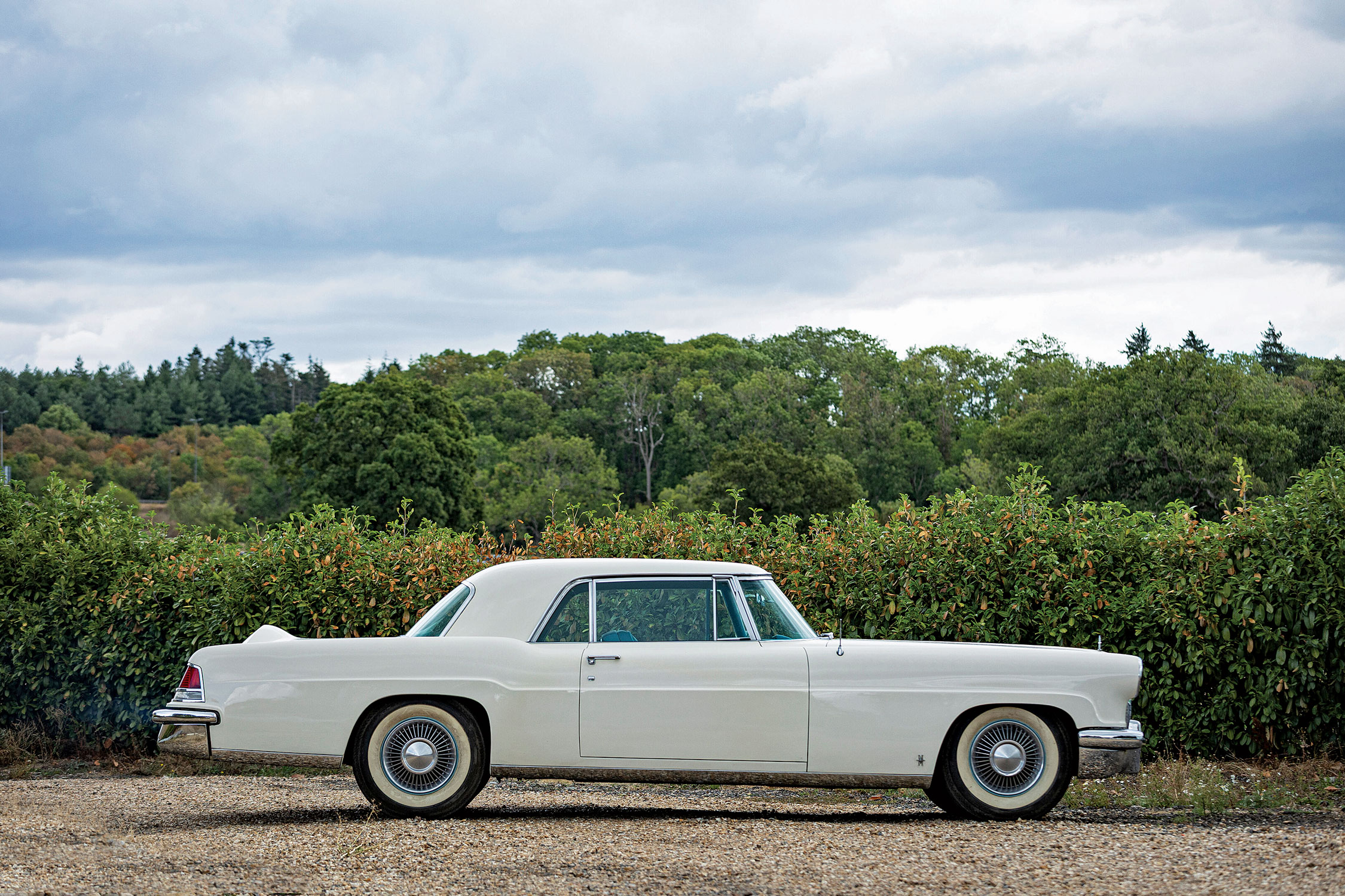
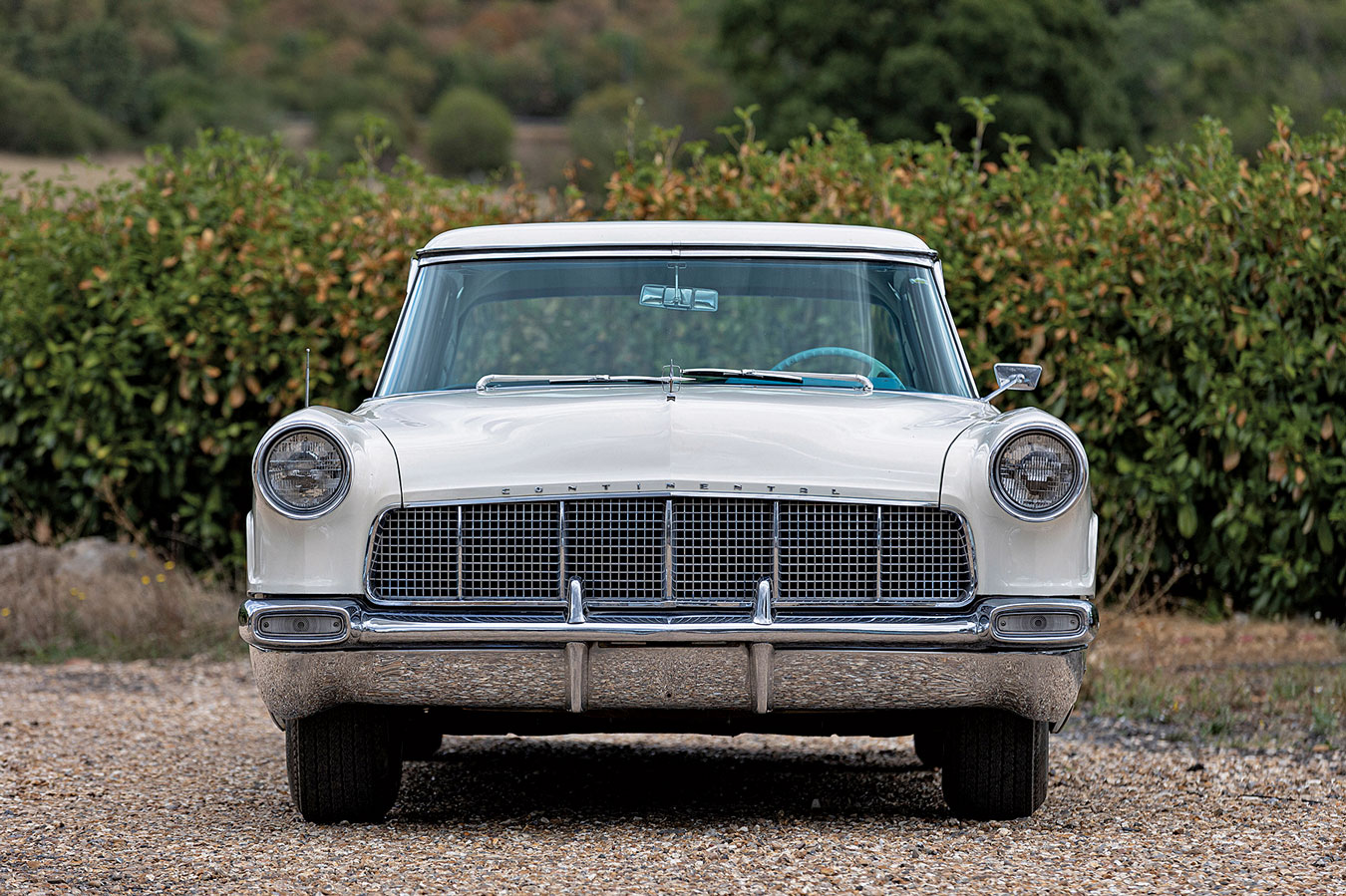
This car, Lot 274, sold for $24,553 (£18,400), including buyer’s premium, at Bonhams’ Chichester, U.K., sale on September 19, 2026.
Even when the original Lincoln Continental went into production for 1940, its styling cues were starting to become passé in continental Europe. When the Continental was reincarnated as a stand-alone brand (while you had to buy a Continental Mark II at a Lincoln dealership, you will not find the name of the 16th U.S. president anywhere on the car), it was introduced at the Paris Auto Show on October 6, 1955. The most European “Continental” styling cue was clean-flowing body lines, with nary a tailfin in sight. It wouldn’t be too out of line to suggest that the 1950s Bentley S1 Continental could’ve been a benchmark for the Mark II. Yet affluent European buyers had little interest in the Mark II — even if it was the most non-stereotypical-looking American car of the 1950s.
Across the sea
Our featured car was one of three that the now-deceased British owner bought while on something of an American Mark II shopping spree in 2019. He purchased this car at Mecum Auctions’ Louisville sale that September for $66,000, fees inclusive. There it was correctly cataloged as a 1957; per the S in the VIN, it was built in April of that year, just a month before Mark II production ended. This time around, Bonhams incorrectly cataloged it as a 1956 — and as a Lincoln. Images from Mecum’s website show it to be a decent car back then, yet $66k was certainly one exit and a rest stop past the market at that time. To me, $50k on the hammer should’ve been the money.
Although it was stated that the car runs and drives, as it spent seven years sitting unattended to in England, I fully concur with Bonhams that the car needs a good mechanical going-over before seriously taking to the road. The Mark II is not the easiest car for a budget-minded collector or self-appointed genius to keep in good order, but at least here in the States it can be done by spending a little more than average for parts compared with any other Ford product of the era. While there are a few specialists here in the U.S. for Mark IIs, none are in the U.K. — or on the Continent, for that matter. Not a good proposition for a Mark II sitting in Old Blighty.
The Mark II is a different animal in several ways compared with the typical 1950s American car. Due to their essentially handmade production, even swapping front fenders is not so easy, because of tighter body-fit tolerances. Expect to have to tweak or modify another fender, even if it came off a parts car. While the 368-ci V8 only differs from any other 1956 Lincoln by having a Carter carburetor (for 15 more horsepower, a change made for all ’57 Lincolns) and unique cast-aluminum valve covers, the exhaust is routed through the rocker panels. The idea at the time was that the heat would bake out any moisture in the rockers; the reality was that both rot out quicker.
Even the wheel covers are notoriously over-built, with every single one of the 40 vanes on each being individually bolted on. That’s 160 nuts and lock washers added to the unsprung weight. All in all, this is a car that requires consulting the experts, and you may just end up shipping it to them to sort out properly. Any wonder that the condition-to-value curve is not linear? A known, well-sorted 1- condition car will bring north of $100k, but even 2- to 3+ condition examples without provenance are in the $30k–$55k range.
Poor results come in threes
As for the consignor’s other two Mark IIs, Lot 126 (C5601531), also purchased in September 2019, sold for parts-car money at $2,302. Since nothing ever dies on the internet, the collector car dealership that likely sold it to him still has it posted. Without a price but marked sold, that car appears to be a decent-looking driver, with a color-change repaint from green to light blue and interior to white with blue inserts. While stated there that the car had “over $6,000 in mechanical work…done to ensure drivability,” it was presented at this auction as being acquired as a “parts car.” Maybe it wasn’t as nice as that dealer purported it to be.
Also in light blue, Lot 272 (C56B2063) was a convertible conversion done in the 1990s. It was purchased at Mecum’s Kissimmee auction in January 2019 for $71,500. It was actually used after crossing the ocean, and compared with the other two, in Mark-edly (pun intended) better condition, but failed to sell at £34k ($45k). It’s worth noting that this same owner also had Lot 273, a 1957 Bentley S1 Continental that also failed to sell, after being bid to £120k ($160k), so I’m not wrong in feeling that car and the Mark II shared the market.
Location, location…
It’s often been said that Ford Motor Company lost about a thousand dollars on each Mark II it sold. The estate for the late consignor should’ve been so lucky. In a way, I’m surprised that Bonhams didn’t pack the Mark IIs into containers and ship them to its U.S. team to find a buyer. They have before. The counterpoint is that they probably figured it wouldn’t be worth the shipping to get that much more money out of them, yet I argue that at worst they’d have paid their own freight. Heck, they would’ve sold better at the local collector car auction in Minot, ND, on Labor Day weekend, rather than at Goodwood.
Hopefully the likely Brit or European buyer is willing to spend what this Mark II needs to be sorted. The car would be considered well bought if the sale was in America, but it was market-correct at Goodwood, even if it’s closer to the Continent.