
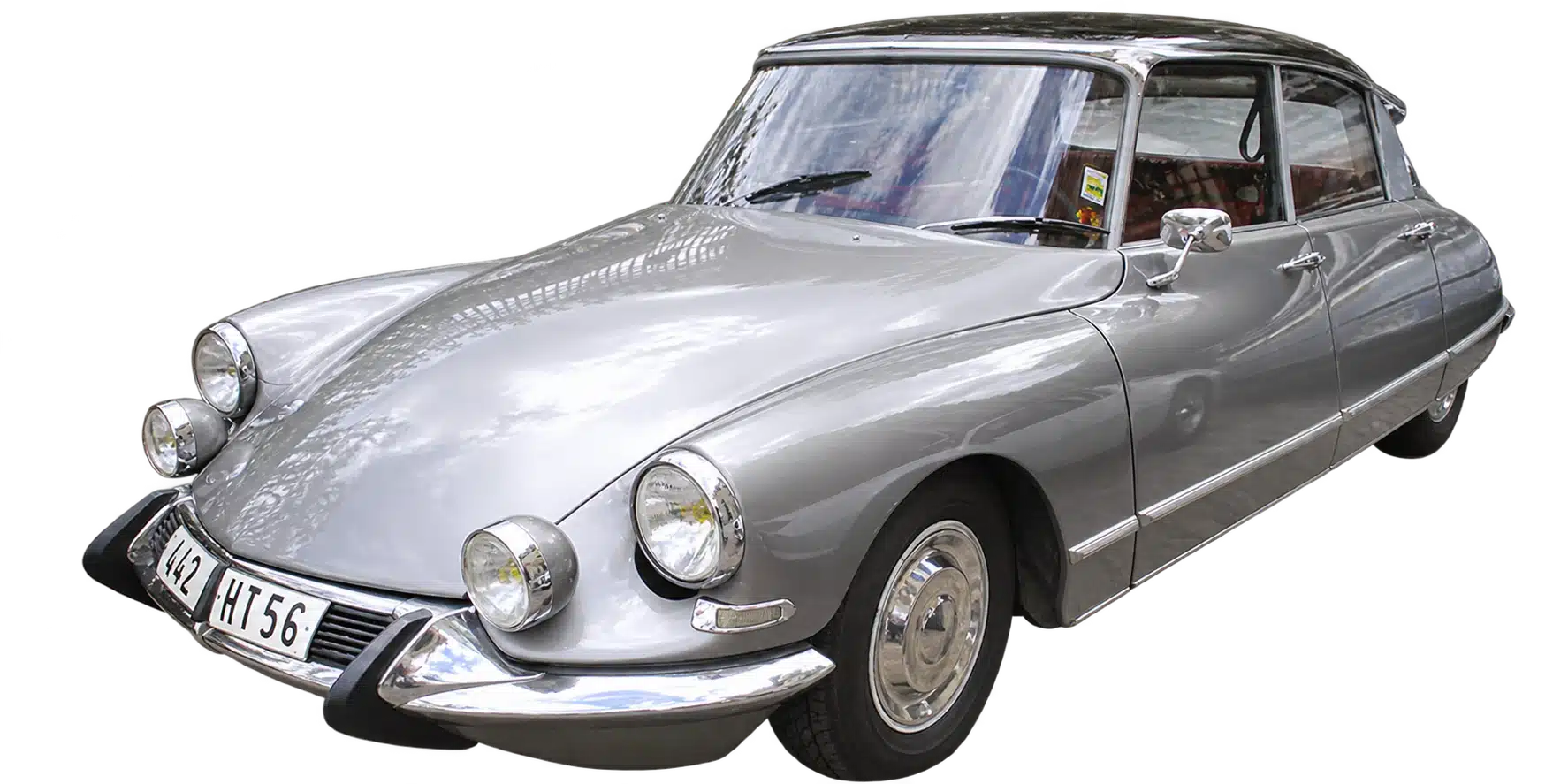
The Citroën DS series, produced from 1955 through 1975, was among the most revolutionary automobiles of the twentieth century. With its aerodynamic bodywork, hydropneumatic suspension, front-wheel drive, power-assisted hydraulic controls and unconventional interior, the DS introduced engineering innovations that were decades ahead of many contemporary competitors. Its combination of comfort, road holding and distinctive styling established an entirely new standard for luxury sedans.
The DS family evolved through several engine and equipment generations, beginning with the DS19 and progressing through the DS20, DS21 and DS23. Citroën also offered the less expensive ID19 and ID20, later renamed DSpécial and DSuper, along with practical Break and Safari station wagons, luxurious Pallas versions and exceptionally rare coachbuilt convertibles and coupes.
Approximately 1.45 million DS-family vehicles were produced across two decades, including the related ID models and commercial derivatives. Although the DS was built in substantial numbers, surviving examples vary enormously in specification, condition and collector value. Early DS19s, fuel-injected DS21 and DS23 Pallas models, and genuine Henri Chapron convertibles are particularly significant.
Origins and Development
Development of the DS began before World War II as a replacement for the groundbreaking Citroën Traction Avant. The project, known as VGD, was pursued under Citroën management with engineering led by André Lefèbvre, styling by Flaminio Bertoni and hydraulic development associated with Paul Magès.
The objective was to create a family automobile that combined exceptional passenger comfort, safe handling, aerodynamic efficiency and advanced mechanical systems.
When the DS19 debuted at the 1955 Paris Motor Show, its appearance and technology astonished the public. Citroën reportedly received approximately 12,000 orders on the first day, demonstrating extraordinary demand for a car unlike anything else on the market.
The DS replaced conventional springs with self-leveling hydropneumatic suspension, introduced power-assisted disc braking and incorporated a hydraulically operated clutch and gear-selection system.
Its name, pronounced Déesse in French, means “goddess,” an appropriate description for a car that quickly became a symbol of French technological sophistication.
Flaminio Bertoni’s Aerodynamic Design
The DS’s body was shaped by the collaboration between Bertoni’s design vision and Lefèbvre’s engineering requirements. Its long, tapering roofline, smooth nose, partially enclosed rear wheels and narrow rear track contributed to excellent aerodynamic efficiency. The body used a steel structural platform with detachable exterior panels. The roof was made from lightweight composite material, while certain other panels used aluminum or steel depending on model and production period.
The wide front track and narrower rear track created a distinctive stance, while the long wheelbase provided generous passenger space.
The DS underwent two major front-end revisions. A subtler redesign appeared for the 1963 model year, followed by the famous 1967 facelift, which introduced four headlights beneath transparent covers on European-market cars. On appropriately equipped versions, the inner headlights turned with the steering, illuminating corners before the car entered them.
The DS’s styling remained remarkably modern throughout its 20-year production run.
Hydropneumatic Suspension
The DS’s most important engineering innovation was its hydropneumatic suspension, which used pressurized nitrogen spheres and hydraulic fluid instead of conventional steel springs. Each wheel was supported by a hydraulic cylinder connected to a sphere containing nitrogen separated from hydraulic fluid by a flexible diaphragm. The compressed nitrogen provided the springing action, while hydraulic components controlled damping and ride height.
The system automatically maintained the correct ride height regardless of passenger or luggage load. Drivers could also select different suspension heights for rough roads, maintenance or changing a wheel. The DS delivered an extraordinarily smooth ride while maintaining impressive handling and stability.
Its ability to travel over uneven surfaces without transmitting severe impacts to passengers became one of its defining characteristics.
Hydraulic Controls and Braking
The DS incorporated a centralized high-pressure hydraulic system that operated several functions beyond suspension. On traditional DS models, hydraulic pressure assisted the steering, braking, clutch operation and gear selection.
The braking system used front disc brakes, making the DS one of the first mass-produced cars to feature this technology. Instead of a conventional brake pedal, the driver operated a small, pressure-sensitive control with very limited travel. The system provided powerful braking but required familiarization.
The hydraulically operated transmission eliminated the conventional clutch pedal while retaining a manual gearbox.
The less expensive ID models initially used simplified hydraulic equipment and more conventional controls, creating an important distinction within the DS family.
Citroën DS19: 1955–68
The DS19 was the original model and established the technological foundation of the entire series. Early cars used a 1,911cc overhead-valve four-cylinder engine derived from the Traction Avant, initially producing approximately 75 horsepower. Although the engine was mechanically conventional compared with the rest of the car, it provided adequate performance for relaxed touring.
The DS19 featured hydropneumatic suspension, hydraulic braking, power steering and a hydraulically operated four-speed transmission.
Engine output gradually increased through improvements in carburetion and tuning. For the 1966 model year, the DS19 received a substantially revised 1,985cc five-main-bearing engine, often identified as the DS19A.
Early DS19s are especially collectible because of their historical importance, distinctive dashboards and original body details.
Citroën ID19: 1957–69
The ID19 was introduced as a less expensive alternative to the DS19. It retained the aerodynamic body and hydropneumatic suspension but eliminated or simplified several expensive hydraulic features. Early ID19s used a conventional manual clutch, manual steering and a simplified braking arrangement. Their engines were also tuned for lower output. Interior trim was more basic, with fewer luxury features and simpler instrumentation.
The ID19 proved popular because it offered the DS’s exceptional ride comfort and futuristic appearance at a substantially lower price. Equipment improved over time, and later ID models became mechanically closer to their DS counterparts.
For collectors, early ID19s offer an interesting contrast with the more sophisticated DS19, while later examples provide a relatively straightforward introduction to DS ownership.
Citroën DS21: 1965–72
The DS21, introduced for the 1966 model year, represented a significant improvement in performance. Its 2,175cc four-cylinder engine initially produced approximately 109 DIN horsepower, with later carbureted versions receiving further improvements. The additional displacement provided stronger acceleration and more relaxed high-speed cruising.
The DS21 retained the sophisticated hydraulic systems and distinctive styling of the DS19 but offered greater flexibility for modern traffic. It became one of the most desirable models in the range, particularly when equipped with Pallas luxury trim.
The DS21 also formed the basis for several coachbuilt convertibles and other special-bodied cars.
Citroën DS21 Injection Électronique: 1969–72
In 1969, Citroën introduced the DS21 Injection Électronique, commonly designated DS21 IE. The engine used Bosch D-Jetronic electronic fuel injection, replacing conventional carburetors. Output increased to approximately 139 SAE horsepower, or around 125 DIN horsepower, depending on the measurement standard. Electronic injection improved fuel metering, throttle response and high-speed performance.
The DS21 IE became one of the fastest and most technically sophisticated DS models available at the time. Its combination of the 2.2-liter engine, fuel injection, advanced suspension and optional luxury equipment makes it particularly attractive to collectors.
However, the injection system introduces additional electrical and fuel-system maintenance requirements.
Citroën DS20: 1968–75
The DS20 replaced the DS19 for the 1969 model year. It used the 1,985cc five-main-bearing four-cylinder engine, with output increasing during production. The DS20 provided a useful balance between economy and performance, particularly compared with earlier DS19 models. It was available with various transmission and trim configurations, including the luxurious Pallas specification.
The DS20 retained the same fundamental chassis, suspension and hydraulic systems as the more powerful DS21 and DS23.
Today, it represents an appealing choice for enthusiasts who want the classic DS experience without the additional complexity of fuel injection.
Citroën DS23: 1972–75
The DS23 was introduced for the 1973 model year and represented the final major development of the DS series. Its engine displaced 2,347cc, making it the largest regular-production engine fitted to the DS. Carbureted versions produced approximately 115 DIN horsepower, while the fuel-injected DS23 IE delivered approximately 130 DIN horsepower.
The additional torque improved acceleration and made the DS more capable of sustained high-speed touring. The DS23 was offered with manual, hydraulically operated and automatic transmission configurations, depending on market and specification.
As the final and most powerful DS generation, the DS23 is particularly desirable among collectors seeking the most developed version of the model.
Citroën DS23 Injection Électronique
The DS23 IE was the ultimate regular-production DS sedan. Its 2.3-liter engine used Bosch D-Jetronic electronic fuel injection, producing approximately 130 DIN horsepower. The fuel-injected engine provided stronger acceleration and improved high-speed performance compared with earlier DS models.
In favorable conditions, the DS23 IE could approach 190 km/h (118 mph), impressive for a large front-wheel-drive sedan of the early 1970s.
The DS23 IE was frequently ordered with Pallas trim, creating one of the most luxurious and technically sophisticated versions of the series.
Today, a well-preserved DS23 IE Pallas with a desirable transmission and complete documentation ranks among the most sought-after regular-production DS sedans.
DSpécial, DSuper and DSuper5
Citroën reorganized the lower-priced ID range for the 1970 model year, introducing the DSpécial and DSuper names. The DSpécial was the entry-level model, retaining relatively simple equipment and conventional manual controls. The DSuper offered improved trim and a more powerful engine, positioning it between the DSpécial and the full DS range.
In 1972, Citroën introduced the DSuper5, which combined the 2,175cc engine with a five-speed manual gearbox. The DSuper5 offered much of the DS21’s performance with a simpler specification, making it particularly appealing to drivers who preferred a conventional clutch and manual gear selection.
These models are often overlooked by collectors but can provide excellent driving enjoyment and comparatively affordable ownership.
Pallas Luxury Specification
The Pallas trim package was introduced in 1964, creating a more luxurious version of the DS. Named after the Greek goddess Pallas Athena, the package incorporated upgraded interior materials, additional sound insulation and distinctive exterior trim. Features included improved seating, richer upholstery, decorative stainless-steel exterior fittings and more elaborate interior appointments.
Pallas equipment evolved during production, and later versions could be specified with leather upholstery, additional comfort features and more sophisticated instrumentation.
The Pallas designation was available on several DS engine variants rather than representing a separate mechanical model.
A DS21 or DS23 Pallas is especially desirable because it combines the car’s advanced engineering with a higher level of comfort and luxury.
Break, Safari and Familiale Station Wagons
Citroën introduced estate versions of the DS/ID family in 1958, with deliveries beginning around the 1959 model year. These cars were marketed under names including Break, Safari, Familiale and Commerciale, depending on configuration and market.
The estate body featured a long roof, enlarged rear cargo area and a distinctive two-piece tailgate. The hydropneumatic suspension was particularly well suited to estate use because it automatically maintained ride height under heavy loads. The Familiale offered additional passenger seating, while the Commerciale emphasized cargo capacity. The Safari name became particularly familiar in Britain and other export markets.
Estate models were used as family cars, ambulances and commercial vehicles. Their practicality and distinctive appearance have made them increasingly collectible.
DS Ambulance and Commercial Variants
The DS platform was well suited to ambulance service because of its long wheelbase, spacious estate body and exceptionally smooth suspension. Specialized ambulance versions incorporated stretcher accommodations, modified interiors and medical equipment.
Commercial derivatives were also used by businesses, public agencies and government organizations. Many were heavily used and eventually scrapped, making original surviving examples relatively uncommon.
Authentic ambulances and commercial vehicles with documented histories can attract collectors interested in the DS’s broader social and industrial significance.
The Chapron Cabriolet d’Usine
The most celebrated open version of the DS was the Cabriolet d’Usine, produced by coachbuilder Henri Chapron with Citroën’s official approval. Introduced for the 1961 model year, the factory-approved convertible combined the DS’s mechanical systems with an elegant two-door open body. The conversion required extensive structural reinforcement, longer doors and redesigned rear bodywork.
Approximately 1,365 factory-approved cabriolets were produced through 1971, including versions based on ID19, DS19 and DS21 mechanical specifications. These cars were sold through Citroën’s official dealer network, distinguishing them from Chapron’s independently marketed coachbuilt models.
Genuine Cabriolets d’Usine are among the most valuable DS-family automobiles, and authentication is essential because replicas and later conversions exist.
Chapron’s Special Coupes and Convertibles
Henri Chapron also produced a range of independently commissioned DS-based coachbuilt automobiles. These included the Le Dandy, Le Paris, Concorde and Le Léman coupes, as well as convertibles such as the La Croisette, Le Caddy and Palm Beach. Each design featured distinctive bodywork, rooflines and interior appointments.
Production numbers were extremely small, and many cars were individually tailored to their original owners. Chapron’s work demonstrated the adaptability of the DS platform and established the model as a basis for exclusive coachbuilt luxury automobiles.
Genuine examples are highly collectible, particularly when supported by original coachbuilder records.
Prestige and Presidential Versions
The DS was also used as an official vehicle by French government officials and prominent public figures. The DS Prestige, developed with Henri Chapron, incorporated a partition between the driver and rear passengers, along with luxury interior appointments. Special presidential and ceremonial vehicles were also constructed, including extended-wheelbase and custom-bodied examples.
The DS became closely associated with French President Charles de Gaulle, whose official cars included Citroën DS models. The model gained particular fame following the 1962 Petit-Clamart assassination attempt, when de Gaulle’s DS escaped despite damage to its tires. The incident reinforced the DS’s reputation for stability and exceptional road holding.
Major Styling Changes
The DS underwent several important styling revisions during its long production run.
- 1955–62: Early cars featured the original rounded nose, exposed single headlights and distinctive early dashboard designs.
- 1963–67: A revised front end improved aerodynamics and gave the car a more streamlined appearance while retaining exposed headlights.
- 1968–75 model years: The major 1967 facelift introduced four headlights beneath transparent covers on European-market cars, with steering-linked directional lighting on appropriately equipped versions.
Interior changes included revised dashboards, improved instruments and updated controls. These styling generations are important to collectors because they create distinctly different appearances despite the shared basic body architecture.
Transmissions and Driving Differences
The DS family used several transmission systems during its production life.
The original DS featured a four-speed hydraulically operated manual gearbox, often described as a semi-automatic or boîte hydraulique. The driver selected gears manually, but hydraulic pressure operated the clutch and gear engagement. Lower-priced ID models used conventional manual transmissions with a clutch pedal. Later DS models offered five-speed manual gearboxes, providing improved high-speed cruising and greater driver involvement. A Borg-Warner three-speed fully automatic transmission became available on selected later models.
Each transmission creates a different driving experience. The hydraulic gearbox is the most characteristically Citroën, while the conventional manual appeals to drivers seeking simpler operation and maintenance.
Hydraulic-System Maintenance
The DS’s hydraulic system is its most important mechanical feature and a major consideration for prospective buyers.
The system relies on a high-pressure pump, accumulator, hydraulic spheres, regulators, valves and extensive plumbing. Common problems include deteriorated seals, leaking pipes, worn pumps and suspension spheres that have lost nitrogen pressure.
Early cars used LHS-type hydraulic fluid, while later models transitioned to LHM mineral hydraulic fluid. The two systems require different compatible seals and components, and the fluids must not be mixed.
A healthy DS should rise smoothly to its normal ride height, maintain correct suspension operation and provide consistent braking and steering assistance.
Hydraulic repairs can be expensive, but specialist suppliers and experienced Citroën mechanics can maintain these systems successfully.
Engine and Cooling-System Problems
The DS’s four-cylinder engines are generally durable when properly maintained. Common concerns include oil leaks, worn valve guides, deteriorated engine mounts and cooling-system corrosion.
Early three-main-bearing engines differ substantially from later five-main-bearing units, making correct identification important when sourcing parts. The larger DS21 and DS23 engines provide improved performance but can suffer from overheating if radiators, hoses or cooling passages are neglected.
Fuel-injected models require additional attention to Bosch D-Jetronic sensors, wiring and fuel-pressure components.
A compression test, cooling-system inspection and review of maintenance records are advisable before purchasing any DS.
Body Corrosion and Structural Restoration
Rust is among the most serious concerns when buying a DS.
Although the exterior panels are detachable, the underlying structural platform can suffer extensive corrosion. Critical areas include the sills, floor pans, chassis box sections, rear suspension mounting points, trunk floor and windshield surrounds. Corrosion may be concealed beneath apparently sound exterior panels, making a thorough underside inspection essential.
The DS’s unusual body construction can make structural restoration complex and expensive. Replacement panels and repair sections are available, but proper alignment and corrosion protection require specialist knowledge.
A structurally sound car is generally a much better purchase than a cosmetically attractive example with hidden rust.
Electrical and Interior Problems
The DS’s electrical system evolved considerably during production and can suffer from aging wiring, poor connections and deteriorated switches. Later models with directional headlights, fuel injection and additional accessories have more complex electrical systems.
Interior restoration can also be expensive because upholstery patterns, dashboard components and trim details vary by model year and specification. Pallas interiors require particular attention to correct materials and decorative fittings.
Original dashboards, instruments and interior hardware are increasingly important to collector value.
Originality and Authentication
Because the DS remained in production for two decades, many cars have been modified with later engines, transmissions, body panels or interior components. Such changes may improve usability but can reduce collector appeal, particularly on early DS19s and rare coachbuilt versions.
Engine numbers, chassis identification and factory specifications should be verified.
Pallas trim has sometimes been added to lower-specification cars, so buyers should confirm whether luxury equipment is original.
Chapron convertibles and coupes require especially careful authentication because of their rarity and substantial value.
Original coachbuilder records, period photographs and ownership documentation are important when evaluating these cars.
Understanding the Major Citroën DS Variants
- DS19 (1955–68): Original DS sedan, initially with a 1,911cc engine and later a revised 1,985cc unit.
- ID19 (1957–69): Lower-cost version with simplified hydraulic equipment and conventional manual controls.
- DS21 (1965–72): More powerful 2,175cc model, available in several trim and transmission configurations.
- DS21 IE (1969–72): Fuel-injected DS21 with Bosch D-Jetronic electronic injection.
- DS20 (1968–75): Revised 1,985cc model replacing the DS19.
- DS23 (1972–75): Final 2,347cc DS generation, offered with carburetion or electronic fuel injection.
- DS23 IE (1972–75): Most powerful regular-production DS, with fuel-injected 2.3-liter engine.
- DSpécial (1969–75): Entry-level successor to the ID range.
- DSuper (1969–75): Better-equipped lower-range model with conventional manual transmission.
- DSuper5 (1972–75): DSuper derivative with 2,175cc engine and five-speed manual gearbox.
- Pallas (1964–75): Luxury trim package available across several DS engine variants.
- Break / Safari / Familiale (1959–75): Estate versions with different seating and cargo configurations.
- Cabriolet d’Usine (1960–71): Factory-approved Chapron-built convertible, approximately 1,365 produced.
- Chapron Coupes and Convertibles: Extremely rare individually coachbuilt versions, including Le Dandy, Concorde, Le Léman and Palm Beach.
- Prestige and Presidential Cars: Chauffeur-oriented and ceremonial derivatives with specialized bodywork and interiors.
Important Sales Reviewed by SCM Experts
In each month’s issue for the past 38 years, SCM’s analysts have reviewed 5 to 7 significant cars sold at auction, and discuss what options, history, or details made that particular more or less valuable. They give their expert opinion on the market for these cars, and whether this car was well bought or well sold. If you’re thinking of purchasing a Citroën DS, you’ll likely find these profiles critical in helping you make the right decision. Each of the following is an article from our print magazine on a Citroën DS sold at auction.
 1970 Citroën DS 21 Décapotable by ChapronThe car carries Chapron body number 9347 and was delivered new in Germany in 1970. In 1979, the original owner sold the Citroën to the second owner, a well-known property developer, who owned the car until he died in 2016. It was always kept in his garage and only driven in summer months. The DS […]Read more

Cars For Sale
Quick links to listings for this make and model online:
Books on the Citroën DS


Note that as an Amazon Associate, we earn from qualifying purchases of the above books.
Past Auction Sales – Citroën DS
Average Citroën DS Sale Price by Year from SCM’s Platinum Auction Database:
Includes sales listed as Citroën DS19, Citroën DS20, Citroën DS21, Citroën DS23.
Citroën DS Sales from SCM’s Platinum Auction Database:

Bonhams Cars
Condition: 2-
Jan 29, 2026
$109,655

Bonhams Cars
Condition: 2-
Feb 6, 2025
$134,033

Gooding & Co.
Condition: 1-
Apr 26, 2024
$123,200

Bonhams Cars
Condition: 3+
Apr 14, 2024
$46,605

Bonhams Cars
Condition: 2-
Jun 4, 2023
$101,920

Artcurial
Condition: 2-
Feb 3, 2023
$167,165

Bonhams
Condition: 2
Oct 9, 2022
$247,864

Bonhams MPH
Condition: 3+
Dec 11, 2020
$22,469

Bonhams
Condition: 3
Jun 30, 2019
$202,849

Artcurial
Condition: 3+
Jun 17, 2019
$26,063

Bonhams
Condition: 2
Jan 17, 2019
$212,800

Artcurial
Condition: 6
Feb 10, 2017
$107,693

Bonhams
Condition: 2
Feb 8, 2017
$221,324

Bonhams
Condition: 3+
Oct 7, 2016
$202,414

Bonhams
Condition: 3+
Mar 20, 2016
$29,988

Bonhams
Condition: 3+
Sep 5, 2015
$256,174

Bonhams
Condition: 2-
Feb 5, 2015
$170,580

Bonhams
Condition:
Dec 9, 2013
$143,756

Artcurial
Condition: 1-
Feb 8, 2013
$130,653

Bonhams
Condition: 1-
Sep 10, 2011
$121,750

Artcurial
Condition: 1-
Jun 13, 2011
$145,481

Bonhams
Condition: 2+
Feb 5, 2011
$253,946

Artcurial
Condition: 2-
Feb 4, 2011
$65,913

Artcurial
Condition:
Feb 4, 2011
$1,607

Kruse
Condition: 1
Jan 16, 1999
$39,900

Bonhams
Condition: 3+
Mar 31, 2022
$15,319

Bonhams Cars
Condition: 2-
Apr 24, 2026
$168,360

Gooding Christie's
Condition: 2
Jan 29, 2026
$60,588

Broad Arrow Auctions
Condition: 2-
Aug 13, 2025
$212,800

Gooding & Co.
Condition: 2-
Apr 26, 2024
$291,000

RM Sotheby's
Condition: 2
Mar 1, 2024
$151,200

Bonhams
Condition: 2
Feb 1, 2023
$214,815

Bonhams
Condition: 2-
Sep 17, 2022
$165,027

Bonhams
Condition: 2-
Jul 3, 2022
$125,543

Gooding & Co.
Condition: 2
Jan 28, 2022
$115,500

Bonhams
Condition: 2
Oct 10, 2021
$266,087

Bonhams
Condition: 2-
Apr 23, 2021
$235,890

Bonhams
Condition: 3+
Mar 3, 2021
$205,137

Artcurial
Condition: 3+
Oct 27, 2019
$23,831

Bonhams
Condition: 3+
Apr 7, 2019
$153,323

Gooding & Co.
Condition: 1-
Mar 8, 2019
$263,200

Bonhams
Condition: 3+
Dec 1, 2018
$219,992

RM Sotheby's
Condition: 2+
May 12, 2018
$219,586

Bonhams
Condition: 3+
Oct 6, 2017
$255,798

VanDerBrink Auctions
Condition: 5
Jul 15, 2017
$10,170

Lucky Collector Car Auctions
Condition: 3-
May 14, 2016
$15,340

Bonhams
Condition: 2-
Feb 4, 2016
$296,399

Bonhams
Condition: 2-
Oct 10, 2014
$225,272

Bonhams
Condition: 3
Apr 28, 2014
$15,498

Bonhams
Condition: 2
Feb 6, 2014
$423,459
See all 78 sales in SCM’s Platinum auction database: Citroën DS · Citroën DS19 · Citroën DS20 · Citroën DS21 · Citroën DS23