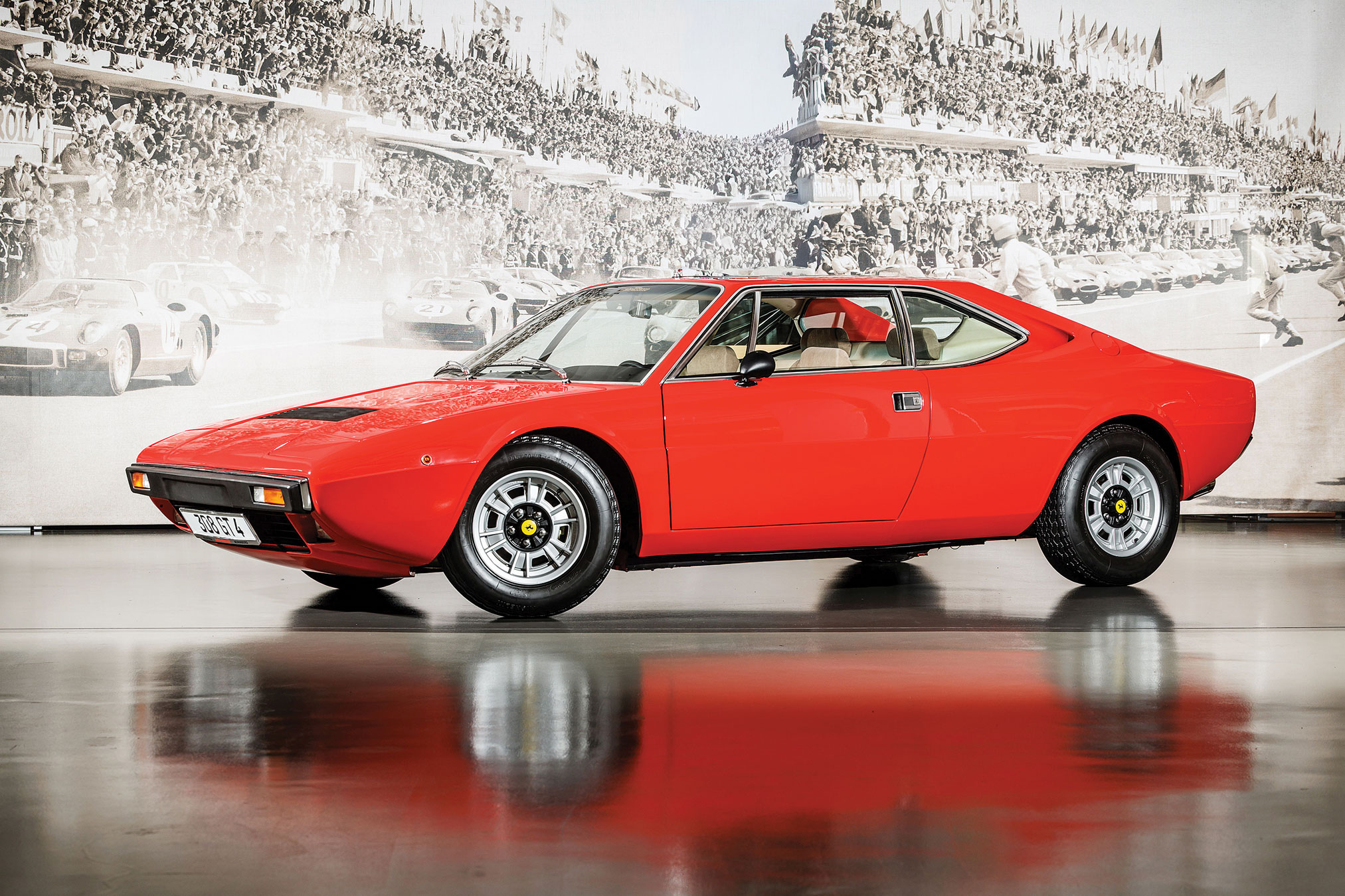
This car, Lot 11, sold for $64,940 (€56,588), including buyer’s premium, at Artcurial’s Paris, FRA, sale, on March 15, 2026.
Fritz Neuser was a celebrated bicycle racer who had participated in the Olympics before opening an auto-repair garage in Nuremberg, Germany. He soon started dabbling in automobile sales, becoming the top German Goggomobil microcar sales outlet in the process. His success did not go unnoticed, as Alfa Romeo then tapped him to sell its product, with Ferrari not far behind. Over the next few decades, he became a highly respected dealer, collector and enthusiast.
You can beat a competitor, but you cannot beat age. A few years back, Neuser shuttered his stores and retired with a lifetime of collecting filling the back of a warehouse. Artcurial was chosen to liquidate 10 Ferraris, 20 non-Ferrari collector cars, and about 300 parts and automobilia items in a one-off auction. Included in the sale was this Ferrari 308 GT4.
Fewer, not less-than
One of the most famous quotes attributed to Enzo Ferrari is, “A Ferrari is a 12-cylinder car.” That apparently didn’t apply to race cars, as 4-, 6-, 8- and 10-cylinder race cars have sported Prancing Horse badges on their noses. This changed with the introduction of a V6 engine inspired and named after Enzo’s son, Dino. Ferrari race cars powered by Dino V6 engines were most often badged as Dinos (one exception being Ferrari’s Formula 1 championship-winning 1958 246 F1 car). When the first production car with a Dino engine was introduced, it was marketed as a Dino.
The 206 and 246 Dino road cars were a great success. They were lovely cars that were a blast to drive, but even the final 195-hp 2.4-liter V6 left drivers wanting more power. The solution came when the Dino 308 GT4 was introduced in 1973 as a successor. A car of “firsts,” it was the first mid-engine 2+2 produced by Ferrari, and the first production Ferrari designed by Bertone. It was also the first production road car to come out of the Ferrari factory to be powered by a V8 engine and the first non-V6 car to wear the Dino name.
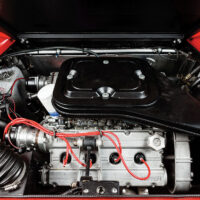
Displacing 2.9 liters (close enough to 3 liters for Ferrari’s numeric naming conventions), the 4-cam V8, topped with four 2-barrel Weber carburetors, was quoted as producing 255 hp. While this represented a significant 60-hp boost over the previous V6, it was the V8’s increase in torque that changed the game. Displacement equals grunt; the added two cylinders and 600 cubic centimeters produced an extra 40 lb-ft of torque, which peaked at 4,750 rpm, 750 rpm less than in the V6. There was no need to wind out the GT4 to get it to perform. It pulled hard from stoplights with minimal effort.
The Bertone body took longer to love. The GT4 silhouette was penned by Bertone stylist Marcello Gandini. Gandini had previously designed Lamborghini’s Miura and Countach, two of the most admired automotive shapes of all time. Gandini was a master of geometrical styling, and Lamborghini was the ideal subject for his haute couture projects. Ferrari’s clients were accustomed to Pininfarina’s more-conservative lines and balked at the GT4’s wedge-like design. Ferrari clients preferred stars to starlets and thought wedges were a way to cut cheese. It would take decades for the design to be appreciated.
The people who did like the GT4 were the people who bought them. The large doors that were needed to get people — well, children — in the 2+2 back seats made entry and exit to the front seats easy. A cab-forward driver’s position, large windshield and steeply angled front hood gave drivers a panoramic view of the road ahead. The gearbox was perfect until the synchros eventually became scratchy. The intake duct behind the passenger’s door that fed air to the Webers amplified the V8’s induction noise, to the delight of occupants.
A six-year run
There were three notable versions of the GT4. As mentioned, the original version was marketed as a Dino with this badge on its nose, steering-wheel horn button and road-wheel center caps. Unofficially, these early examples are known as Series I. Like the V6 Dinos before them, the VIN plate on U.S.-market Dinos revealed the car was built by Ferrari, negating the myth that Dinos were less than Ferraris.
By late 1975, Ferrari gave up the charade that a Dino was a separate marque. New production cars wore Ferrari badges from the factory, and dealers were sent instructions to replace Dino badging on prior cars with that of Ferrari. These models are unofficially known as Series II.
The final GT4 version was introduced in 1977 and featured an optional sunroof and an updated dash with improved air conditioning. The sunroof was a nice touch, but the upgraded A/C was a game changer, making the GT4 a truly usable summer car. These Series III cars are relatively rare, but surprisingly, they do not sell for a premium.
Meanwhile, U.S.- and European-market 308 GT4s primarily differed by federalization requirements. U.S. cars had obtrusive DOT-mandated black rubber 5-mph impact bumpers, large rectangular side-marker lights and other safety equipment. They also had federally mandated emission equipment that siphoned off as much as 50 horses from the European configuration.
Better than bad
Many GT4s were, as the saying goes, ridden hard and put away wet. High mileage, cheap repaints and neglected maintenance was the norm for decades. In 2021, a $105k Bring a Trailer sale brought more attention to the model. The following year, a well-restored GT4 grabbed headlines after selling on BaT for $225k. In 2023, Gooding & Company sold the first 308 GT4, the Paris Show car, at its Pebble Beach auction for an astonishing $450,500.
This Neuser sale was a surprise. Chrome-bumper Euro-market GT4s are the preferred models, and a 24,000-km example, restored by a Ferrari dealer, should have broken records. Instead, the $65k sale did not even pass the low end of Artcurial’s $69k–$92k (€60k–€80k) pre-auction estimate.
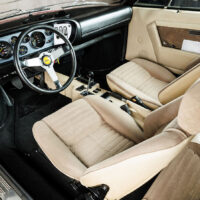
Closely examining the auction photos, the Neuser car was a no-option cloth-and-vinyl-interior example. The restoration failed to fully conceal a former accident repair that was not done well, with the nose badge missing and the depression where it should be filled in flush with the surrounding bodywork. The red paint was not entirely excellent, as the left front fender showed dull paint and a possible tape line. This GT4 may have been one of Mr. Neuser’s favorite cars, but this was not among the greatest examples. It sold right on the money.