
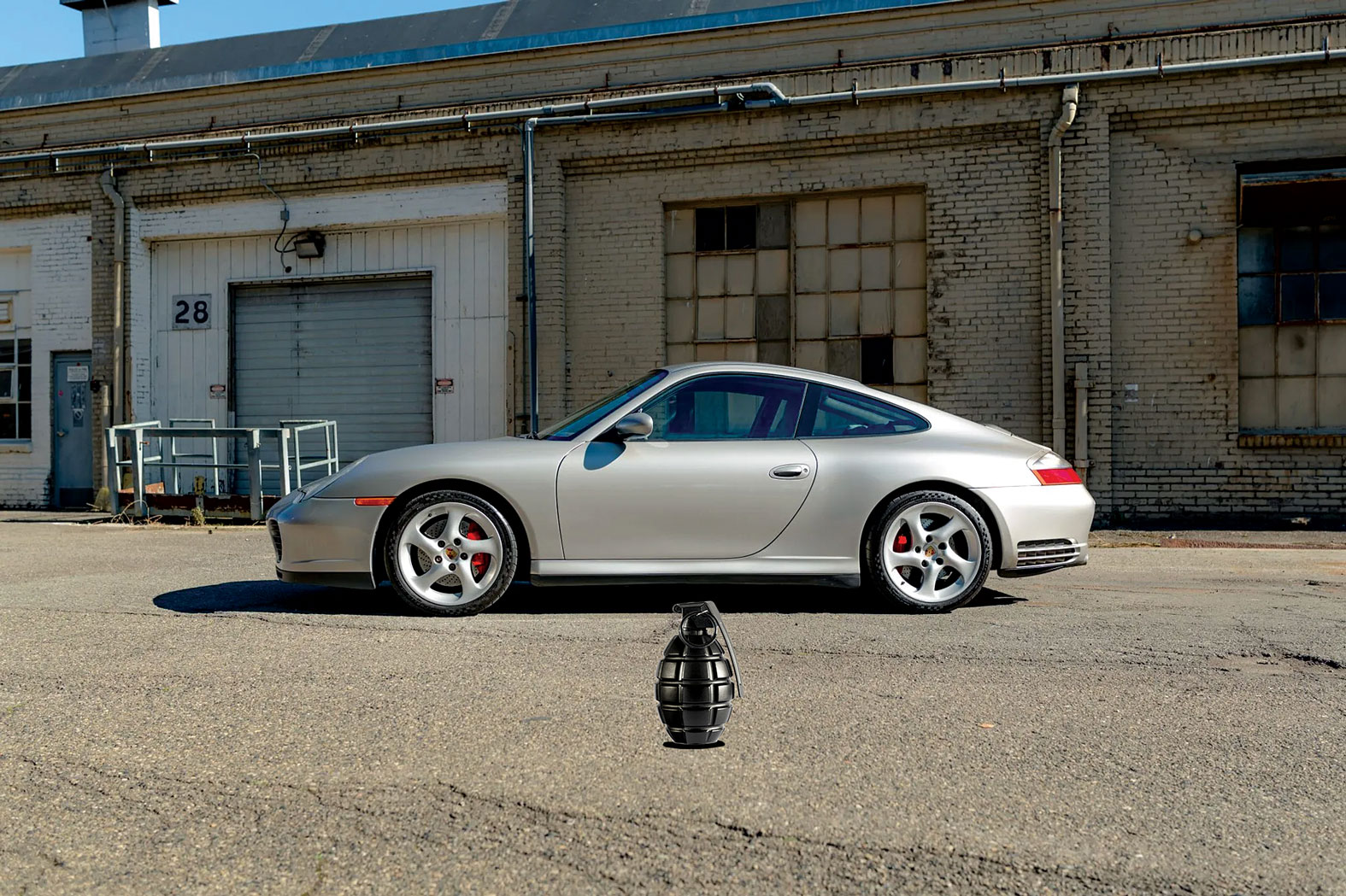

Well, the pin’s still in it for now … The grenade is already in the garage. But I don’t know how far the pin has been pulled. Our 2005 Porsche 911 C4S is not my first rodeo with a 911. But the kerfuffle around its IMS bearing outweighs all the controversies surrounding my previous ones combined. The bearing was used from 1997 through 2005. While I’m not going to get into all the details and the debate over replacement, suffice it to say that if mine should fail, that will be the end of the engine in my car. Mo’ Porsches, […]
Well, the pin’s still in it for now …
The grenade is already in the garage. But I don’t know how far the pin has been pulled.
Our 2005 Porsche 911 C4S is not my first rodeo with a 911. But the kerfuffle around its IMS bearing outweighs all the controversies surrounding my previous ones combined.
The bearing was used from 1997 through 2005. While I’m not going to get into all the details and the debate over replacement, suffice it to say that if mine should fail, that will be the end of the engine in my car.
Mo’ Porsches, mo’ problems
Over the years, I’ve owned a few classic air-cooled 911s, including a 1968 911L that had its OEM chain tensioners collapse halfway through a tour.
There was also a 6-speed Boxster S, which used a similar IMS-bearing-plagued M96 engine as our C4S, but I owned that car before these failures became widely known (resulting in a class action lawsuit against Porsche).
Next was a 996 Carrera — again, before I was aware of the issue. I kept wondering why the seller, an Alaska Airlines aircraft mechanic, kept insisting I look at the oil filters he had cut open, saying, “No metal, no metal, no metal.”
Then there was the 996 Turbo, which had a “Mezger” flat-6 that doesn’t suffer from the IMS-bearing affliction. I probably should not have sold that one.
Most recently, our much-loved 1975 911 Sportomatic delivered its own saga, when we discovered the typical broken head studs.
Easy breezy
This brings us back to our current example, the 911 C4S with its Tiptronic automatic.
I want more comfort on the 1,000-mile Porsche tours the local club conducts. The G-body Sporto — with no power steering, power brakes or A/C — was delightful to drive, but not easy.
By the end of a day guiding the car through the twisties, I was, quite literally, toasted.
I started looking for a 996 Tiptronic. Frankly, I wasn’t interested in a 997 with its PDK dual-clutch automatic. To start with, they are significantly more expensive. Porschephiles decry the Tiptronic as inferior to the quick-shifting PDK; however, it’s not much of an advantage when I rarely, if ever, drive in anger. I’m touring in the car, not tracking it.
Whether PDK or Tip, in my past experiences with these automatic Porsches, I have found myself shifting furiously for only the first few miles. Then the novelty kind of wears off and I just leave the car in drive, letting the gearbox do what it does best, which is shift when it wants to.
Butt wait… there’s more
I didn’t know what a C4S was until I started sharing the cars I was finding with Avant-Garde Collection owner Matt Crandall (911r on BaT) and SCM Contributor Philip Richter. To my surprise, both of them waxed enthusiastically about this model, calling it the best-looking of the whole series, with its fat fenders and clean, no-spoiler rear end.
I had become an instant 996 sophisticate.
The car I bought has gorgeous Arctic Silver paint with full-leather Anthracite Gray interior, a clean-enough CARFAX and a few service records. But none for the IMS bearing. The odometer showed 70,510 miles. It was loaded, with an original MSRP of $96,705 in 2005. I paid $33,000 for it, which seemed about right.
The real bonus was its location, only 180 miles away. At 5 a.m. one morning, my son Bradley took the Amtrak train to Seattle, picked up the car, and was home by 2 p.m.
Then we began to do our due diligence. (Yes, after the purchase. Some things never change.)
Stuttgart roulette
My car’s VIN is WPOAA299357620075 and the engine number is M960366500527.
We sent it to Matt’s shop for an evaluation and a recommendation about the IMS bearing. We had heard stories about replacement ranging from $3,000 to $8,000, depending on the specifics and while-you’re-in-theres.
During this whole process, I had learned from our Editor-in-Chief, Jeff Sabatini, that he had researched this issue while on staff at Car and Driver. He told me there was no reliable way to tell if an IMS bearing was “going bad.” And when they fail, they destroy engines. Despite this knowledge, Jeff had gambled by not replacing the bearing in the Boxster S that he had owned for a few years.
When Avant-Garde’s head tech, Chris Smith, reported back, he told us the following:
“I don’t have 100% faith in what Porsche reports about IMS bearings and engine numbers. I won’t know until I tear into it what bearing it has and whether it is serviceable.
“Because your car is a Tip with AWD, it will take a lot of hours just to get to the bearing, and once we do, we might find out it is non-serviceable, or that the the bearing had already been dealt with. We could end up spending 20 to 30 hours for nothing.
“As this is such a late-production car, and those reportedly had a low failure rate, my recommendation is that we just do nothing and take our chances.”
However, longtime SCM Contributor and Porsche expert Jim Schrager told me he doesn’t like the idea of playing Stuttgart roulette. He immediately services the IMS bearing on any 996 911 he acquires.
I had been determined to do the same. But the information from Chris, who I also regard as a 911 guru, caused me to rethink the whole situation.
So we slid the partially pulled pin back into the grenade.
Will I be slightly nervous each time I take the car out? Yes, of course. At least there shouldn’t be any warning signs for me to stress about, just a big kablooie, probably while I’m in the middle of nowhere on a tour.
With old cars, you pays your money and you takes your chances. The SCM mantra is that old cars create adventures. This one is just beginning.