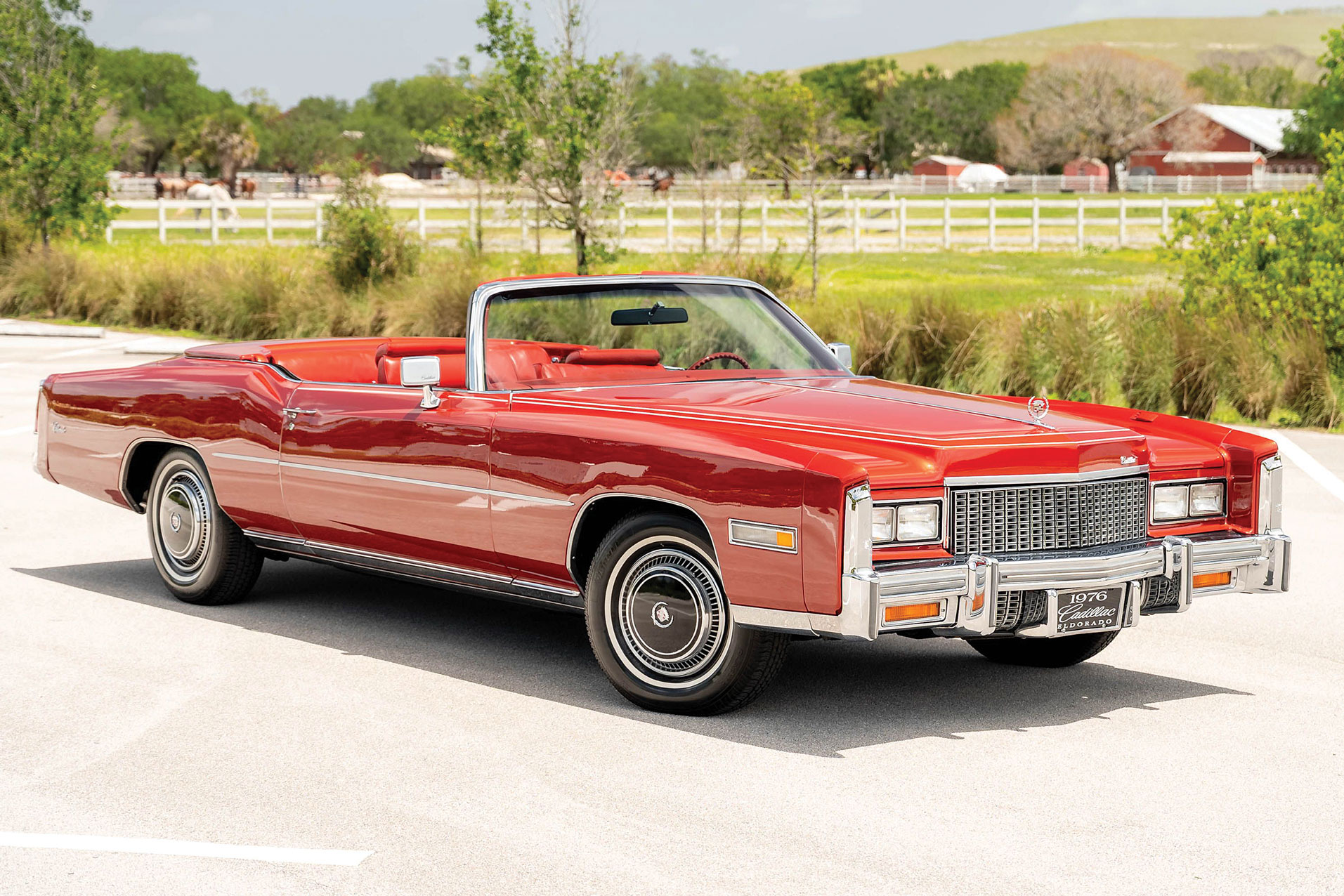
This car, Lot 42, sold for $56,000, including buyer’s premium, at Bonhams Cars’ Greenwich, CT, sale, on May 31, 2026.
In 1636, the burgeoning Dutch tulip industry was shaken to its roots by bulbs that sprouted petals that had mysterious streaked or flamed-color patterns. A single example reportedly traded for the price of a grand Amsterdam canal house. While the scope of “tulip mania” has since been debated, historians concur that it was likely the first recorded example of perceived scarcity driving a boom, only to be followed by a bust when the panic proved baseless.
Such was the case with the nearly last American convertible, the 1976 Cadillac Eldorado. Like the 1978 Chevrolet Corvette Pace Car and C4 ZR-1 that followed (GM seems to have suffered a bit more tulip-like tumult than other brands), the announcement that the 1976 Eldorado would be Cadillac’s final convertible immediately sparked full-on hoarding of the 14,000 examples built for the final model year.
Pressing the crease
Planning for the ninth-generation Eldorado, scheduled for the 1971 model year, began in the late 1960s, a time when GM’s “Standard of the World” division had approached 240,000 units by 1969, nearly a 60% increase from 1960. But few of those sales came from the division’s Eldorado flagship, introduced at the 1953 Motorama show and put into limited production the same year. Swaddled in chrome and flaunting post-war prosperity, it was reconceived for 1967 on GM’s E-Body architecture as a front-wheel-drive, coupe-only model. Thanks to its Bill Mitchell-inspired “crease in the pants” styling, demand boomed, expanding to nearly a tenth of divisional sales by 1969.
That growth was not lost on Ford, whose Lincoln Mark III and Mark IV eventually eclipsed Eldorado sales. Using the Thunderbird as their basis, the Marks achieved scale benefits noticed by GM, which shifted the ninth-generation 1971 Eldorado redesign to the higher-volume B-Body family, retaining front-wheel drive.
Size matters
The multi-division consolidation stretched the Eldorado’s wheelbase by a stunning 6.3 inches, creating dramatic proportions enhanced with a lengthy beveled hood and distinct fender profiles that hinted at pre-war “suitcase” designs. The convertible rejoined the lineup, barely avoiding oblivion due to looming safety standards and increased adoption of air conditioning. It represented unapologetic flamboyance that channeled the great open phaetons of the pre-war period, with seating for six and the added benefit of a flat floor. Power came from a 500-ci V8 producing a smog-constrained 190 hp in base form and 215 hp in optional fuel-injected trim, starting in 1975. Four-wheel disc brakes arrived the following year.
Those elements were enough to push convertibles to a fifth of overall Eldorado sales. But when GM announced that its production would end with the 1976 model year, the feeding frenzy was on. By October 1976, reported The New York Times, Eldorados with an $11,000 base price were being bought straight off delivery trucks for $20,000 or more — with final fully-loaded 200 Bicentennial editions selling for up to $100,000.
Waiting for the payday
Many of those Eldorados were squirreled away in the hopes of sizable payoffs. Fast-forward 50 years, though, and only the best-maintained cars are commanding premium pricing, such as a $92,400, 1,959-mile special-order pale yellow version at Broad Arrow’s Amelia auction earlier this year, or a slightly sinister triple-black 3,500-mile example that sold on BaT for $140k in 2024. At the other extreme are drivers that trade for a fraction of that amount. “Prices for these cars swing wildly,” says Frank Nicodemus of Cadillac Parts & Restoration. “Mileage is the critical factor, but other considerations are rust, a functional air-conditioning system and the complex scissor top, all of which are costly to repair — if you can find someone to do it.”
Our subject car is finished in especially attractive Firethorn Red Metallic, one of 21 hues for the pre-Bicentennial cars, with a matching interior. Puzzling is the undocumented low mileage, a concern given the age-related risks of limited usage. That, and the “driver quality” description might explain why it hammered so far below its pre-sale estimate of $80k–$110k. We only hope that the buyer was able to make a functional inspection ahead of a substantial expenditure. Barring any surprises, however, this example traded appropriately within the broad range of final-year Eldorado pricing.
With 55,000 ninth-generation units built, these massive convertibles have built a loyal following. Kent Bain, founder of Connecticut’s Automotive Restorations, has fond memories of top-down towing a Triumph racer behind his convertible: “A bit floaty, but very comfortable. Reliable, powerful and unfussy.” Recent buyer Mark Lowham says his triple-white 1976 model “captures a golden moment in history when Frank Sinatra, Bob Hope and Doris Day filled our television screens with optimism and happiness. Driving that car evokes just those sentiments for me every day, and it has been one of my favorite investments.”
So maybe most of these era-ending Eldorados didn’t deliver the great returns their owners expected, but they can still create a driving experience that’s just not available anymore — and certainly not at this price.