
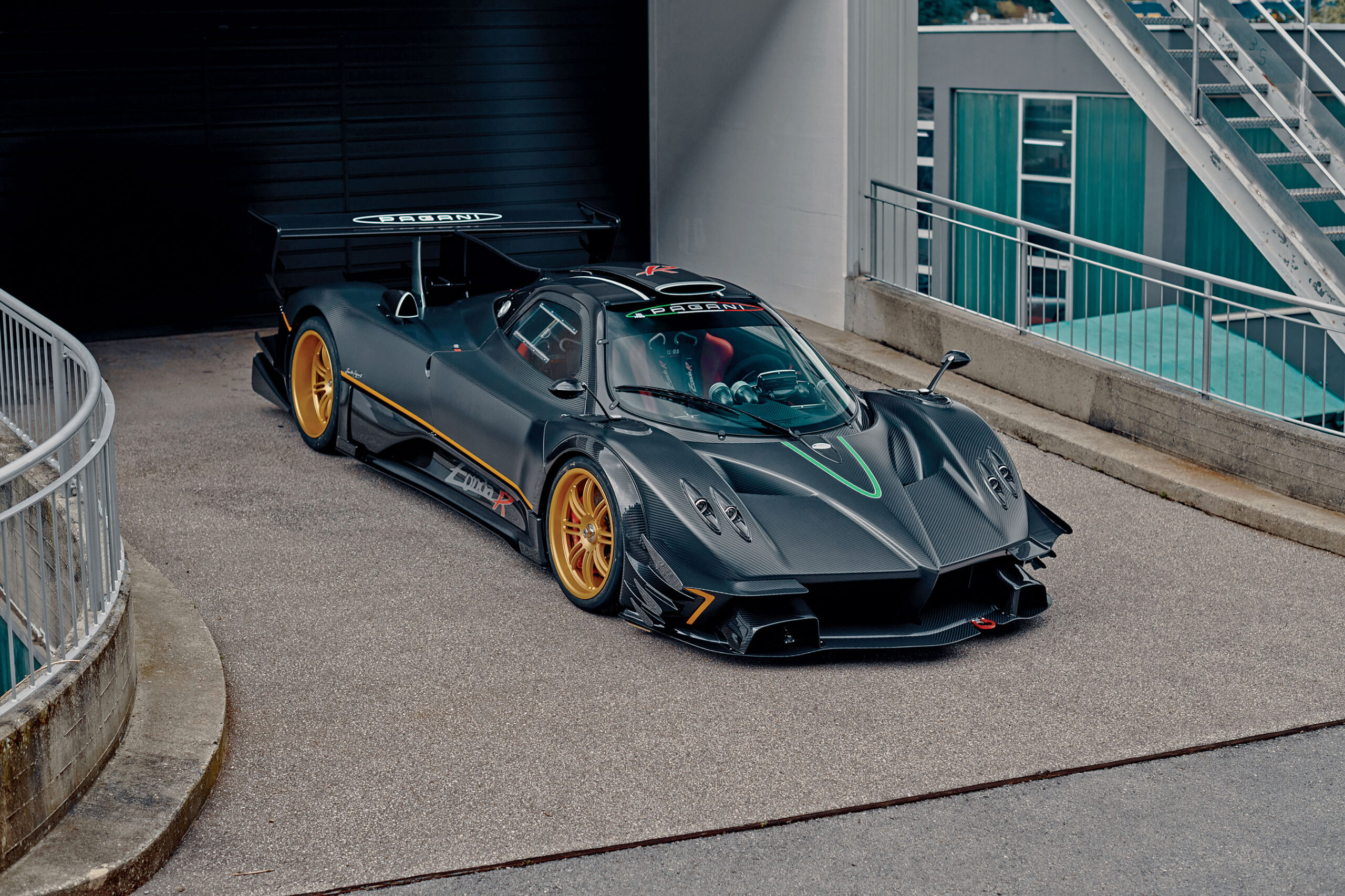
Chassis Number: 05

See articles and past auction sales of the Pagani Zonda.
This car, Lot 171, sold for $5,340,000, including buyer’s premium, at RM Sotheby’s Amelia Island, FL, sale on March 4, 2023.
Horacio Pagani spent his engineering career pioneering and perfecting various lightweight materials. He initially worked at Renault and Lamborghini, where he innovated with composites, then created Modena Design, a consultancy that still produces composites for different F1 cars and serves major clients such as Daimler, Aprilia and Ferrari. Based on this expertise — and a healthy dose of passion — Pagani founded his own car company, Pagani Automobili S.p.A., in 1992.
A good run
In 1999, Pagani launched its first production car, the Zonda, named for a hot north wind that sweeps down from the Andes Mountains over the Argentine pampas. Its production run lasted 20 years, although since 2013 this has consisted only of intermittent one-offs coaxed out of the factory by special order.
Every Pagani is something of a bespoke masterpiece — each detail is meticulously considered and crafted. During its lifetime, the Zonda evolved and improved through several variants, as a coupe, convertible and barchetta were all conceived. Over time, engine displacement increased, manual transmissions were improved and sophisticated automated manuals were offered. This development culminated in a radically reworked non-street-legal track car, the Zonda R, which debuted in 2007. Six years later, the ultimate Zonda R, the Revolución, was first shown.
The Zonda R’s on-track performance bona fides were attested to by its 2010 Nürburgring time, which trimmed a little over 10 minutes off the Ferrari 599XX’s mark for non-street-legal vehicles at the time. Without going fully down the rabbit hole of controversy surrounding Nürburgring lap times, let’s just say that it’s a bit of an exaggeration for the auction catalog to claim the Zonda R still holds a “record” of much merit. Not when more than half a dozen cars have since been quicker, including a Porsche 911 GT2 RS, a Mercedes-AMG GT Black Series and a Lamborghini Aventador SVJ — all street legal.
Tip of the top
Regardless, the Zonda sits atop the mountain alongside a handful of truly memorable 21st-century supercars, a […]
With an SCM subscription, you’ll have the information, tools, and advice you need from 50+ world-renowned authorities on collector cars to make the best decisions for buying, selling and collecting classic and sports cars.
- 18 printed issues per year: 12 monthly magazines + 6 special guides
- 150+ printed pages every month that help you be a smarter collector
- Access to 38 years of back issues
Already a subscriber? Login to read the article.
| Vehicle: | 2010 Pagani Zonda R “Revolución Specification” |
| Years Produced: | 2009–11 |
| Number Produced: | 15 |
| Tune Up Cost: | $27,000 |
| Club Info: | Pagani Owners Club |
| Website: | https://www.pagani.com |
| Alternatives: | 2005–07 Ferrari FXX, 2006 Maserati MC12 Corse, 2015–16 Aston Martin Vulcan |
This car, Lot 171, sold for $5,340,000, including buyer’s premium, at RM Sotheby’s Amelia Island, FL, sale on March 4, 2023.
Horacio Pagani spent his engineering career pioneering and perfecting various lightweight materials. He initially worked at Renault and Lamborghini, where he innovated with composites, then created Modena Design, a consultancy that still produces composites for different F1 cars and serves major clients such as Daimler, Aprilia and Ferrari. Based on this expertise — and a healthy dose of passion — Pagani founded his own car company, Pagani Automobili S.p.A., in 1992.
A good run
In 1999, Pagani launched its first production car, the Zonda, named for a hot north wind that sweeps down from the Andes Mountains over the Argentine pampas. Its production run lasted 20 years, although since 2013 this has consisted only of intermittent one-offs coaxed out of the factory by special order.
Every Pagani is something of a bespoke masterpiece — each detail is meticulously considered and crafted. During its lifetime, the Zonda evolved and improved through several variants, as a coupe, convertible and barchetta were all conceived. Over time, engine displacement increased, manual transmissions were improved and sophisticated automated manuals were offered. This development culminated in a radically reworked non-street-legal track car, the Zonda R, which debuted in 2007. Six years later, the ultimate Zonda R, the Revolución, was first shown.
The Zonda R’s on-track performance bona fides were attested to by its 2010 Nürburgring time, which trimmed a little over 10 minutes off the Ferrari 599XX’s mark for non-street-legal vehicles at the time. Without going fully down the rabbit hole of controversy surrounding Nürburgring lap times, let’s just say that it’s a bit of an exaggeration for the auction catalog to claim the Zonda R still holds a “record” of much merit. Not when more than half a dozen cars have since been quicker, including a Porsche 911 GT2 RS, a Mercedes-AMG GT Black Series and a Lamborghini Aventador SVJ — all street legal.
Tip of the top
Regardless, the Zonda sits atop the mountain alongside a handful of truly memorable 21st-century supercars, a member of an elite club that includes the Bugatti Veyron and Chiron, Ferrari Enzo, Koeingsegg CCX and Maserati MC12. But the Zonda is a landmark beyond its exclusivity and performance. Its build quality and attention to detail surpass most modern supercars from producers large and small. It will forever be known as the first Pagani, the car that built the legacy and led to the Huayra (not to mention the forthcoming Utopia). Pagani used the anything-goes R as a bridge between its 1990s-developed Zonda and the fully modern Huayra, which went into production in 2011. So the Zonda is an important car in the annals of supercar stardom, the R variant even more so.
While the R is the “ultimate” Zonda and the Revolución is the highest-spec R, it is also not street legal. Even as our subject car was upgraded to Revolución specification by the factory, it was originally a “stock” R — if you can apply that term to any car built in a quantity of just 15. Ultimately, in the market for investment-grade track cars, this probably ranks at the pinnacle.
Find another
A public sighting of any Pagani is an outlier event — but it’s impossibly rare to see a Zonda out in the wild, on the street or driving down the road. It’s equally unusual to see one at a public auction. Huayras come to sale far more commonly, with the handful of recent results for the Zonda’s successor indicating that interest and demand for all things Pagani is solid.
This combination of rarity and scarcity also makes it difficult to assess the value of our subject car. We’ve seen just one recent public sale of a Zonda, a one-off, street-legal roadster built in 2017 that was sold by RM Sotheby’s at its Abu Dhabi sale in 2019 for $6.8m. Other comparable sales would include the track-only 2006 Maserati MC12 Corse sold at Bonhams’ Scottsdale this year for $3.8m. With our subject car landing at the midway point between the two, the price would seem fair.
Let’s be honest, though. When it comes to assessing this sale, you can throw the metrics and comps out the window. The modern supercar market has been absolutely on fire lately, with buyers routinely engaging in bidding wars over Ferrari Enzos, Porsche Carrera GTs and even Ford GTs, driving prices for all three to new heights. And those are “common” cars, with examples seen at most big auctions. This was likely a once-in-a-lifetime opportunity to own a Zonda R, and the buyer made the most of it. ♦
(Introductory description courtesy of RM Sotheby’s.)


