
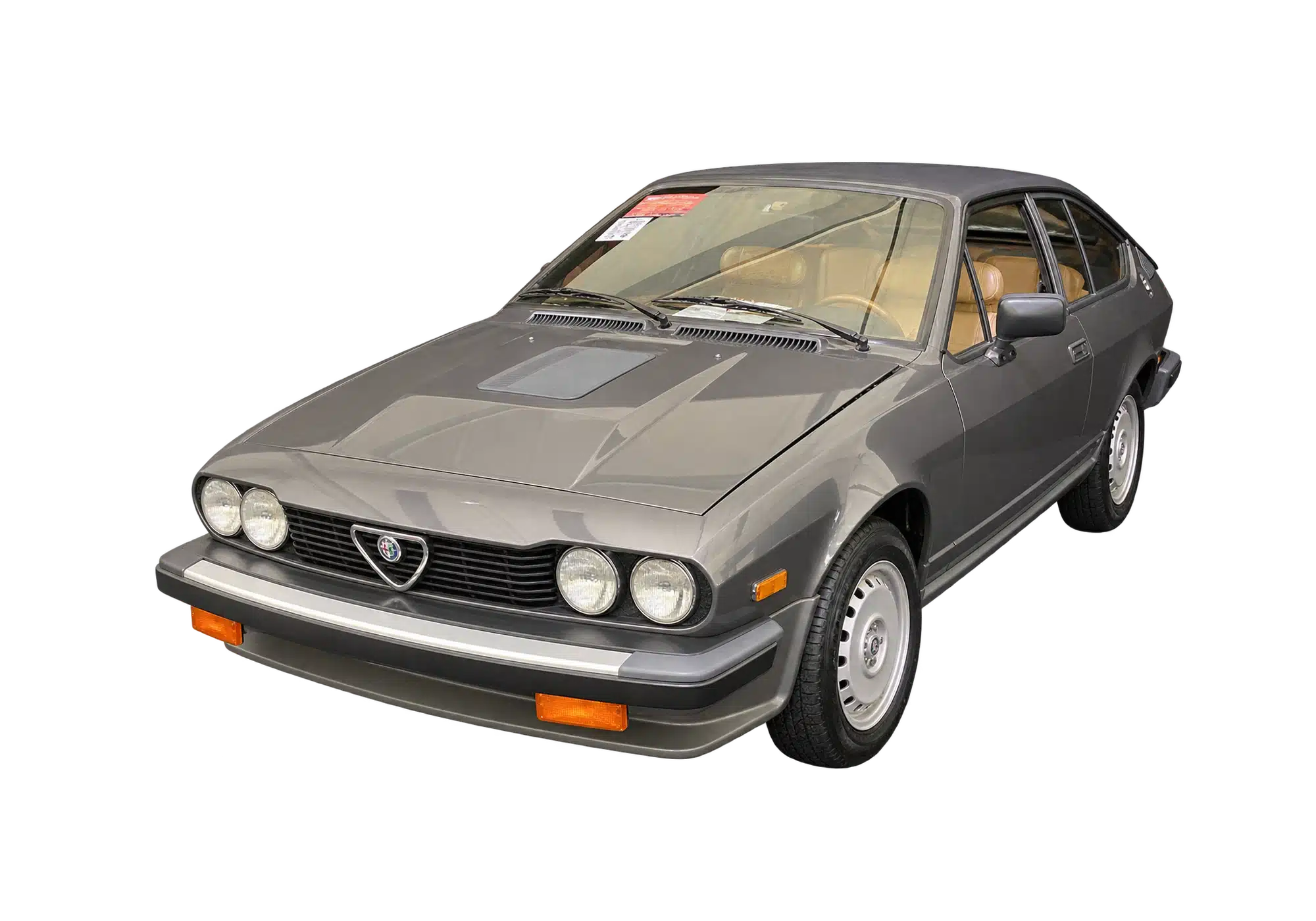
The Alfa Romeo GTV6, produced from 1980 through 1987, is one of the most charismatic Italian sports coupes of the 1980s. Combining Giorgetto Giugiaro’s angular fastback styling, Alfa Romeo’s sophisticated rear-transaxle chassis and the celebrated 2.5-liter Busso V6, the GTV6 delivered an unusually rewarding blend of handling, performance and mechanical character.
Developed from the four-cylinder Alfetta GT and GTV, the GTV6 introduced a fuel-injected six-cylinder engine, revised styling and improved grand-touring performance. Its distinctive hood bulge, near-balanced weight distribution and unmistakable V6 exhaust note distinguished it from contemporary competitors such as the Porsche 924, Mazda RX-7 and BMW 323i.
Although most GTV6s were powered by the standard 2.5-liter engine, the model also spawned several important variations. These included the rare South African GTV6 3.0 homologation special, the American Callaway Twin Turbo, market-specific versions and successful touring-car racing derivatives.
Today, the GTV6 is increasingly recognized as one of Alfa Romeo’s most engaging modern classics. Its sophisticated chassis and exceptional engine provide lasting appeal, while corrosion, transmission wear and deferred maintenance make careful selection essential.

1977 Alfa Romeo Alfetta GT coupe, from an auction in Scottsdale on January 23rd, 2026
Origins: From Alfetta GT to GTV6
The GTV6 traces its origins to the Alfetta GT, introduced in 1974 as a sporting coupe derived from Alfa Romeo’s Alfetta sedan.
Styled by Giorgetto Giugiaro at Italdesign, the Alfetta GT featured a sharply defined wedge profile, long hood, large rear hatch and distinctive angular glasshouse. Its design was modern for the period and provided a practical four-seat alternative to conventional two-seat sports cars.
The original Alfetta GT used Alfa Romeo’s twin-cam four-cylinder engines, initially in 1.8-liter form, with 1.6-liter and 2.0-liter versions following. The most important feature was its transaxle chassis, which placed the clutch and gearbox at the rear of the car rather than directly behind the engine. This arrangement contributed to excellent weight distribution and became central to the model’s handling character.
By the late 1970s, however, the four-cylinder GTV faced increasingly powerful competition. Alfa Romeo responded by installing the 2.5-liter V6 developed for the Alfa 6 luxury sedan. The resulting GTV6 2.5 debuted in 1980, transforming the Alfetta coupe into a substantially more powerful and refined grand tourer.

1984 Alfa Romeo GTV6 2.5 Autodelta coupe, from an online auction on February 19th, 2021
Giugiaro Styling and the GTV6 Facelift
The GTV6 retained the basic shape of the Alfetta GT but incorporated several changes introduced with the 1980 facelift. The earlier chrome bumpers were replaced by larger black plastic units, while revised exterior trim gave the car a more contemporary appearance. The most recognizable difference was the prominent hood bulge, necessary to accommodate the taller V6 engine and its intake system.
The GTV6 retained the angular front end, long side windows and large glass rear hatch that made the original Giugiaro design distinctive. The rear incorporated updated taillights, black trim and a spoiler integrated into the lower portion of the hatch.
Although less delicate than the chrome-bumper Alfetta GT, the GTV6’s styling has aged well and is now closely associated with Alfa Romeo’s performance cars of the 1980s.
The 2.5-Liter Busso V6
The centerpiece of the GTV6 was its 2,492cc naturally aspirated V6, designed under the direction of Alfa Romeo engineer Giuseppe Busso. The engine featured a 60-degree cylinder-bank angle, aluminum block and cylinder heads, a single overhead camshaft for each bank and two valves per cylinder. European versions generally produced approximately 160 horsepower, although output varied according to market and emissions requirements.
The engine used Bosch L-Jetronic electronic fuel injection, providing more precise fuel delivery than the carbureted engines used in some earlier Alfa Romeo models. The Busso V6 was celebrated for its smooth power delivery, willingness to rev and distinctive exhaust note. Its sound became one of the defining characteristics of the GTV6. Compared with the earlier four-cylinder GTV, the V6 offered substantially stronger torque and more relaxed high-speed cruising.
The engine was also relatively compact and lightweight, making it well suited to the Alfetta’s front-engine, rear-transaxle architecture.

1981 Alfa Romeo GTV6 2.5 coupe, from an auction on October 4th, 2024
GTV6 2.5: 1980–87
The standard GTV6 2.5 accounted for the overwhelming majority of production. It combined the 2.5-liter Busso V6 with a five-speed manual transaxle and rear-wheel drive.
European models typically produced around 160 horsepower, while U.S.-specification cars were rated at approximately 154 horsepower under SAE net standards.
The GTV6 offered a distinctive combination of performance and practicality, with seating for four, a large rear hatch and reasonable luggage capacity. Its handling was particularly impressive, benefiting from the transaxle layout and De Dion rear suspension. Although the basic mechanical specification remained largely unchanged, interior equipment, trim and certain components evolved during production.
Later examples generally benefited from improved interior layouts and incremental refinements, making them attractive to enthusiasts seeking a more usable classic.
U.S.-Market GTV6: 1981–86
The GTV6 entered the American market for the 1981 model year and remained available through 1986. U.S.-specification cars incorporated emissions equipment, lighting and safety components required by federal regulations.
The 2.5-liter V6 produced approximately 154 SAE net horsepower, with output varying slightly by model year.
American cars were generally well equipped, reflecting Alfa Romeo’s positioning of the GTV6 as a premium European sports coupe. The U.S. market also received several distinctive trim and appearance packages during the model’s production run.
Because the GTV6 was sold in relatively modest numbers in America, surviving original examples are increasingly desirable, particularly when they retain their factory interiors, wheels and mechanical specifications.
The GTV6 Balocco
The GTV6 Balocco was a special appearance edition offered in the United States during the early 1980s.
The Balocco SE (Special Edition) was specifically a 1982 model-year U.S. limited edition (350 units produced, all finished in red with black leather interiors, a sunroof, and special badging).
Named after Alfa Romeo’s Balocco proving ground in Italy, the package featured distinctive exterior graphics, special trim and equipment intended to emphasize the car’s sporting character.
The Balocco retained the standard 2.5-liter V6 and five-speed manual transaxle. Its principal differences were cosmetic rather than mechanical.
Original Balocco cars are relatively uncommon, and collectors should verify the authenticity of their graphics, trim and factory equipment.

1984 Alfa Romeo GTV6 Maratona coupe, from an auction on April 1st, 2005
The GTV6 Maratona
The GTV6 Maratona was another special edition offered in the American market. The Maratona was a 1984 model-year U.S. special edition (with ~150 produced, available in silver or red with distinctive Aero body kits and Speedline wheels).
It featured distinctive aerodynamic body components, including a front air dam, side skirts and additional exterior trim. The package gave the GTV6 a more aggressive appearance while retaining the standard 2.5-liter engine and drivetrain.
Maratona examples are particularly recognizable because of their body kits and period styling.
As with other limited-production appearance editions, originality is important. Some standard GTV6s have received similar aftermarket bodywork, making documentation desirable.
The Callaway GTV6 Twin Turbo
One of the most significant American-market derivatives was the Callaway Twin Turbo GTV6, developed by Reeves Callaway’s Connecticut-based engineering company.
Callaway installed twin turbochargers on the 2.5-liter Busso V6, substantially increasing power and torque. The conversion also incorporated changes to engine management, cooling and other mechanical systems to accommodate the additional performance.
Approximately 30 Callaway Twin Turbo GTV6s were produced during the mid-1980s, although exact counts vary among historical accounts. The Callaway cars offered performance approaching that of considerably more expensive European sports cars. They also helped establish Reeves Callaway’s reputation for sophisticated turbocharging, preceding his better-known work with Chevrolet Corvettes.
Today, genuine Callaway GTV6s are highly collectible because of their rarity, engineering significance and connection to an important American performance specialist. Authentication is essential because turbocharged conversions have also been performed by independent owners and workshops.
South African GTV6 3.0: The Homologation Special
The South African GTV6 3.0 is among the most desirable versions of the model. Developed during the early 1980s, it was created to improve Alfa Romeo’s competitiveness in South African touring-car racing, particularly against larger-engined BMWs.
The engine was enlarged to 2,934cc using special components developed with assistance from Alfa Romeo’s competition organization, Autodelta. Unlike the standard fuel-injected 2.5-liter GTV6, most South African 3.0-liter cars used six Dell’Orto carburetor throats, contributing to a distinctive intake sound and strong performance. Output was approximately 174 horsepower, with substantially greater torque than the 2.5-liter version.
The South African 3.0 also featured distinctive bodywork, including a larger hood bulge, deeper front spoiler and specialized wheels. Approximately 212 examples were built, primarily to satisfy local motorsport homologation requirements.
The GTV6 3.0 achieved considerable success in South African racing and remains one of the most historically significant Alfa Romeo homologation specials of the 1980s.
South African GTV6 3.0 Variations
Although most South African 3.0-liter cars used carburetors, a very small number of late examples reportedly received fuel injection.
Individual cars can also differ in competition equipment, interior trim and mechanical specification. Because the South African GTV6 3.0 was produced in extremely small numbers, surviving examples often have complicated histories involving racing, modifications or restoration. A genuine factory-sanctioned South African 3.0 should be distinguished from a standard GTV6 subsequently converted to a larger Busso engine.
Original engine components, bodywork, chassis identification and South African production records are particularly important when evaluating these cars.
The Transaxle Drivetrain
The GTV6’s unusual drivetrain was inherited from the Alfetta. The engine was mounted longitudinally at the front, while the clutch, five-speed gearbox and differential were located together at the rear. Power was transmitted through a driveshaft running between the engine and rear transaxle.
This layout distributed weight more evenly between the front and rear axles, improving balance and handling. However, the arrangement also introduced mechanical complexity and contributed to the GTV6’s characteristic gearshift feel. The gearbox was operated through a relatively long linkage, and shifts could feel notchy or imprecise compared with conventional front-mounted transmissions. Second-gear synchronizer wear became a particularly common problem.
Despite these compromises, the transaxle layout was central to the GTV6’s exceptional handling character.
De Dion Rear Suspension
The GTV6 used a De Dion rear suspension system, an unusual arrangement for a production sports coupe of the period. Unlike a conventional live axle, the De Dion system separated the differential from the wheel-supporting axle assembly. The differential was mounted to the body, reducing unsprung weight, while a rigid tube maintained the relationship between the rear wheels.
The arrangement provided good wheel control and consistent camber while preserving much of the durability of a solid axle. Combined with the transaxle layout, the De Dion suspension contributed to the GTV6’s excellent traction and predictable handling.
The front suspension used double wishbones with torsion bars rather than conventional coil springs. This sophisticated chassis arrangement helped distinguish the GTV6 from many contemporary sports coupes.
Steering and Brakes
The GTV6 used rack-and-pinion steering, providing direct feedback and precise directional control. Its relatively balanced weight distribution reduced the heavy front-end feel associated with some conventional front-engine sports cars. Four-wheel disc brakes were standard, with inboard rear discs mounted near the differential.
The inboard arrangement reduced unsprung weight but made brake maintenance more difficult because the calipers were located close to the transaxle. Brake performance was generally good for the period, although the original system could suffer from fade during sustained hard driving.
Worn suspension bushings, steering components and brake calipers can significantly affect handling and stopping performance.
Performance
The GTV6 offered strong performance by early-1980s standards. European 2.5-liter models were capable of approximately 130 mph (210 km/h), with 0–60 mph acceleration in the region of 8–9 seconds. The V6’s broad torque delivery made the car particularly enjoyable on winding roads and during high-speed touring.
The South African 3.0 offered stronger acceleration and greater midrange performance, while the Callaway Twin Turbo delivered substantially more power than the standard model.
The GTV6’s greatest strength was not outright acceleration but the combination of engine character, balanced handling and steering precision. Its relatively compact dimensions and sophisticated suspension made it particularly rewarding on challenging roads.
Racing Success
The GTV6 enjoyed a successful competition career, particularly in European touring-car racing. Prepared by Alfa Romeo’s competition department and independent racing teams, the GTV6 achieved major victories against strong international competition. The model won the European Touring Car Championship manufacturers’ title in four consecutive seasons, from 1982 through 1985.
Racing versions incorporated revised engines, suspension, brakes, bodywork and safety equipment. The GTV6 also competed successfully in rallying, including Group A events, demonstrating the versatility of its chassis. Its racing record contributed significantly to the model’s reputation and helped establish the Busso V6 as an important performance engine.
The GTV6 in Popular Culture
The GTV6 achieved additional recognition through its appearance in the 1983 James Bond film Octopussy. In a memorable sequence, James Bond commandeers a GTV6 and drives it through Germany while attempting to reach a military base.
The film helped introduce the model to a broader international audience and reinforced its image as an exciting European sports coupe. Although cinematic appearances are not central to the car’s mechanical significance, they contribute to its cultural identity and collector appeal.
Engine Reliability and Maintenance
The Busso V6 is generally regarded as a durable engine when properly maintained. Its aluminum construction, strong bottom end and relatively conservative state of tune contribute to long service life.
However, several maintenance issues deserve attention.
- The engine uses a timing belt, which requires periodic replacement. Failure can cause serious internal damage.
- Cooling-system condition is particularly important because overheating can damage cylinder heads and gaskets.
- Oil leaks, aging seals, deteriorated hoses and worn valve guides are common concerns on high-mileage or neglected examples.
- The Bosch L-Jetronic fuel-injection system is generally reliable, but old wiring, sensors and fuel-system components can cause running problems.
A properly maintained GTV6 should start readily, idle smoothly and pull strongly through the rev range.
Transmission and Clutch Problems
The GTV6’s transaxle is one of its most important maintenance considerations. Second-gear synchronizer wear is particularly common, often producing grinding or resistance during shifts. The shift linkage can also develop excessive play as bushings and joints deteriorate.
Early GTV6s used a twin-plate clutch arrangement, which can be expensive to service. Some cars have been converted to later single-plate clutch configurations.
Worn transaxle mounts can produce clunks or vibration during acceleration and gear changes.
The driveshaft uses flexible rubber couplings, commonly called guibos, which can crack or deteriorate with age. Failure of these components can cause severe vibration and potentially damage surrounding drivetrain parts.
A prospective buyer should inspect the complete drivetrain carefully, particularly on cars with uncertain maintenance histories.
Rust and Structural Problems
Corrosion is among the most serious concerns when purchasing a GTV6. Common rust locations include the rocker panels, floor pans, wheel arches, door bottoms, jacking points and rear hatch surround. The front suspension mounting areas, inner fenders and windshield surround also require careful inspection.
Water leaks around the rear hatch can lead to corrosion in the luggage compartment and surrounding structure.
Because the GTV6 uses a steel unibody, severe corrosion can compromise structural integrity and make restoration expensive. Replacement panels are available from specialist suppliers, but extensive structural repairs require careful workmanship.
A rust-free or properly restored GTV6 is generally a better purchase than a mechanically sound car with significant structural corrosion.
Suspension and Brake Maintenance
The GTV6’s sophisticated suspension requires regular inspection. Worn front suspension bushings, ball joints and torsion-bar mounting components can affect steering precision.
At the rear, De Dion tube bushings, Watts linkage components and suspension mounts can deteriorate. The inboard rear brake calipers are particularly vulnerable to neglect because they are relatively difficult to access. Seized calipers, leaking hydraulic components and worn discs can require substantial labor to repair.
A properly maintained GTV6 should feel balanced and responsive, with predictable steering and stable braking.
Interior and Electrical Problems
The GTV6’s interior reflects Alfa Romeo’s distinctive approach to driver ergonomics during the 1980s. Early cars featured an unusual instrument arrangement, with certain gauges positioned separately from the main instrument cluster. Later cars received revised dashboards with more conventional instrumentation. Interior materials included cloth, velour and leather, depending on market and specification.
Common problems include deteriorated seat upholstery, cracked dashboards, worn switches and malfunctioning electrical accessories. Electrical faults are often caused by aging wiring, poor ground connections and corroded connectors.
Original interior components can be difficult to source, making complete, well-preserved examples particularly desirable.
Originality and Authentication
The GTV6 has long been popular with enthusiasts who modify their cars for improved performance. Common modifications include larger 3.0-liter or 3.2-liter Busso engines, upgraded suspension, aftermarket wheels and performance exhaust systems. These changes can improve driving enjoyment but may reduce collector value when originality is important.
The South African GTV6 3.0 and Callaway Twin Turbo require especially careful authentication because their rarity makes them substantially more valuable than standard examples.
Factory records, engine specifications, original body components and documented ownership history should be examined.
For standard GTV6s, original paint, interior trim, wheels and mechanical components are increasingly desirable.
A well-maintained original car is generally preferable to a heavily modified example of uncertain quality.
Understanding the Major Alfa Romeo GTV6 Variants
- GTV6 2.5 (1980–87): Standard production model with 2,492cc Busso V6, Bosch L-Jetronic fuel injection and five-speed rear transaxle.
- U.S.-Market GTV6 (1981–86): Federalized version with market-specific emissions, lighting and equipment.
- GTV6 Balocco: American-market special appearance edition with distinctive graphics and trim.
- GTV6 Maratona: American-market appearance package with aerodynamic body components and special exterior trim.
- Callaway GTV6 Twin Turbo (mid-1980s): Extremely rare American twin-turbocharged conversion, with approximately 30 produced.
- South African GTV6 3.0 (1983–85): Homologation special with 2,934cc V6, revised bodywork and approximately 212 produced.
- South African GTV6 3.0 Fuel Injection: Very rare late-production variation of the South African 3.0.
- GTV6 Competition Cars: Touring-car and rally versions prepared for international and national motorsport.
The earlier four-cylinder Alfetta GT, GTV 2000 and GTV Turbodelta belong to the same broader model family but are mechanically distinct from the V6-powered GTV6.
Important Sales Reviewed by SCM Experts
In each month’s issue for the past 38 years, SCM’s analysts have reviewed 5 to 7 significant cars sold at auction, and discuss what options, history, or details made that particular more or less valuable. They give their expert opinion on the market for these cars, and whether this car was well bought or well sold. If you’re thinking of purchasing a Alfa Romeo GTV6, you’ll likely find these profiles critical in helping you make the right decision. Each of the following is an article from our print magazine on a Alfa Romeo GTV6 sold at auction.
 Alfa Romeo GTV6: Best of the Bottom-FeedersThe Maratona edition was referred to as the “Marijuana” edition, in reference to what Alfa must have been smoking at the time 2007-11_2084 For many Alfisti (our esteemed Publisher included), the saga of Alfa Romeo in the U.S. effectively ends after 1967, when emission controls began to sap their essential “Alfa-ness.” Having driven his ’65 […]Read more
Cars For Sale
Quick links to listings for this make and model online:
Books on the Alfa Romeo GTV6


Note that as an Amazon Associate, we earn from qualifying purchases of the above books.
Past Auction Sales – Alfa Romeo GTV6
Average Alfa Romeo GTV6 Sale Price by Year from SCM’s Platinum Auction Database:
Includes sales listed as Alfa Romeo Alfetta GT, Alfa Romeo GTV6 2.5.
Alfa Romeo GTV6 Sales from SCM’s Platinum Auction Database:

Bonhams Cars
Condition: 2-
Oct 4, 2024
$43,680

Silverstone
Condition: 3+
Feb 25, 2023
$78,156

RM Sotheby's
Condition: 3+
Feb 19, 2021
$79,999

H&H Auctioneers
Condition: 3+
Oct 17, 2018
$21,386

Mecum Auctions
Condition: 3
Apr 9, 2010
$6,200

eBay
Condition: 4
Aug 25, 2008
$1,926

eBay
Condition: 3
Oct 2, 2006
$4,800

eBay
Condition: 3
Oct 2, 2006
$4,500

eBay
Condition: 3-
May 1, 2006
$9,101

eBay
Condition: 4
Jul 1, 2005
$183

Barrett-Jackson
Condition: 3
Apr 1, 2005
$8,640
Forums & Communities
Popular Videos about the Alfa Romeo GTV6


