Photo courtesy Cars and Bids
Tesla recently announced that its groundbreaking Model S was being discontinued after an impressive run of 15 years. Somewhat coincidentally, I recently saw a white Model S pop up on the lot of a friendly used-car dealer. Possessing an enthusiast’s impulse to ignore “soulless” electric cars, and keen on resisting any shifting political influence on the auto industry, I haven’t really paid much attention to Tesla.
I’m actually a good candidate to drive an electric car — politics, image and dedication to internal combustion aside. I own multiple other vehicles and live in a house with a garage where I could have a charger installed. And I have a scant four-mile commute to the office each day. I probably do some of my collector cars more harm than good on days I fail to take the long way home to let them properly warm to operating temperature. Having recently read all about the Porsche bore-scoring issue, during our brutal Midwestern winter every cold start of my 987 Cayman S or my trusty daily-driver Macan S had me wincing in pain.
There’s a bigger reason why I’ve turned a blind eye to electric cars: depreciation-phobia. Often, my excuse for puttering around in older cars is that I simply can’t stand the thought of using my car as an appliance, losing value with every turn of its odometer. As a Porsche fan, I’d most definitely noticed the recent dramatic drop in electric Taycan prices. Once they get under 30 grand, I thought, when further depreciation should be negligible, I might consider one. Well, as my dealer friend told me, the Model S has been there for a while now.
First time for everything
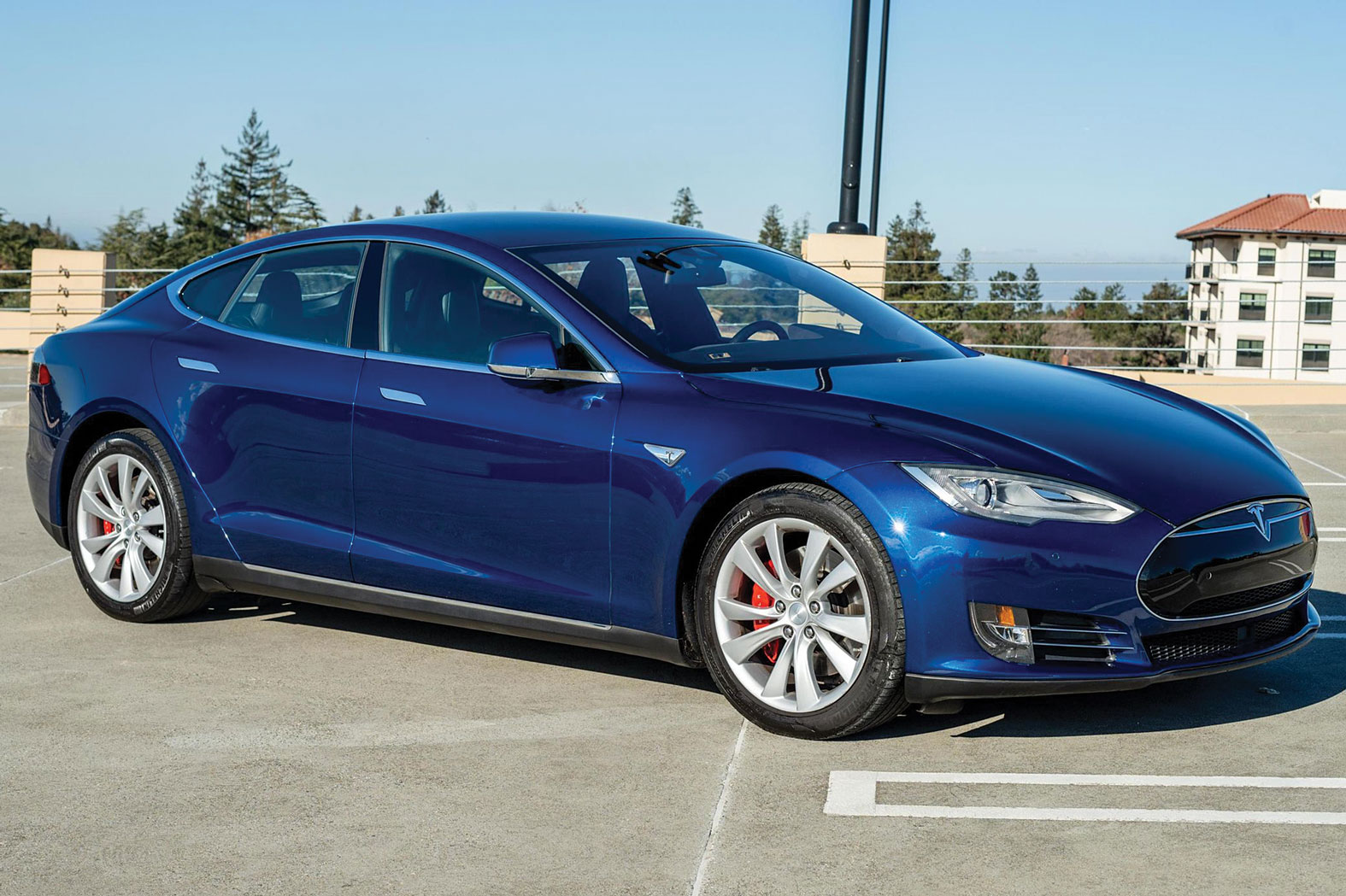
I had never even driven an electric car before. Outside of a handful of Uber rides, these were totally unchartered waters. But now, with my dirty Porsche left as collateral, I was tossed a “key” fob, and a 2015 Model S P85D was mine for the weekend.
The first step on my learning curve came quickly. With no start button, gearshift or obvious way […]
Photo courtesy Cars and Bids
Tesla recently announced that its groundbreaking Model S was being discontinued after an impressive run of 15 years. Somewhat coincidentally, I recently saw a white Model S pop up on the lot of a friendly used-car dealer. Possessing an enthusiast’s impulse to ignore “soulless” electric cars, and keen on resisting any shifting political influence on the auto industry, I haven’t really paid much attention to Tesla.
I’m actually a good candidate to drive an electric car — politics, image and dedication to internal combustion aside. I own multiple other vehicles and live in a house with a garage where I could have a charger installed. And I have a scant four-mile commute to the office each day. I probably do some of my collector cars more harm than good on days I fail to take the long way home to let them properly warm to operating temperature. Having recently read all about the Porsche bore-scoring issue, during our brutal Midwestern winter every cold start of my 987 Cayman S or my trusty daily-driver Macan S had me wincing in pain.
There’s a bigger reason why I’ve turned a blind eye to electric cars: depreciation-phobia. Often, my excuse for puttering around in older cars is that I simply can’t stand the thought of using my car as an appliance, losing value with every turn of its odometer. As a Porsche fan, I’d most definitely noticed the recent dramatic drop in electric Taycan prices. Once they get under 30 grand, I thought, when further depreciation should be negligible, I might consider one. Well, as my dealer friend told me, the Model S has been there for a while now.
First time for everything
I had never even driven an electric car before. Outside of a handful of Uber rides, these were totally unchartered waters. But now, with my dirty Porsche left as collateral, I was tossed a “key” fob, and a 2015 Model S P85D was mine for the weekend.
The first step on my learning curve came quickly. With no start button, gearshift or obvious way to propel the car forward, I was at a loss as to what I was supposed to do once I was buckled into the driver’s seat. “Pretend you’re activating your windshield wipers,” my friend patiently said, as he pointed to the lever on the right side of the steering column. “Down is forward, and up is reverse,” he explained, as we whirred into motion. “No need to ever turn the car on or off. It just knows you’re done driving when you exit.”
I have had to keep up with understanding the power of technology in my day job, so another thing he said to me really hit home — “Think of it as a life-size iPhone on wheels.” Like when a newspaper advertisement became a Google AdWord, I clearly needed to retrain my brain to what a car is, how it works, and what it is capable of doing. I was still living in the past, with my seemingly quick Cayman S. Those meager expectations were about to be propelled into another dimension.
There have been countless variations of the Model S offered over the years, but this one was a top-of-the-line model for its time. The “P” in the nomenclature is for performance, and the “D” is for dual, indicating two electric motors, producing a combined 463 horsepower. Together, they push the car from standstill to 60 mph in 3.3 seconds. (Granted, this model is already as antiquated as an iPhone 6, with the advent of 1,020-horsepower “Plaid” editions.) The lack of any shifting by the driver — or even computer — assists in its quickness and, once tapped into Sport steering and suspension settings via the large touchscreen, this near 5,000-pound sedan handles much like a proper sports car. However, I never got entirely past the feeling that computers are providing its performance and “feel.”
A Tesla driver certainly doesn’t miss visits to the gas pump, although range anxiety is a real disorder. Perhaps my most difficult experience with the car was upon realizing that of all the adaptors included in the mobile charging kit, the only one that my house was currently set up to accept was the paltry 120-volt connection. At about 1% per hour plugged in, it was more like a trickle charge, though this could be easily remedied with a call to an electrician. Advance trip planning was necessary and, yes, putting the car into “Insane” mode to enable those 3-second sprints sucks the juice quickly.
Epilogue
Speaking of crazy, I did wonder if once the novelty of pure, adrenaline-inducing speed wears off, I might miss that primal connection to the car. The one that comes from human activity and input, where the car’s performance improves as yours does. (Remember, I am a Porsche guy.) This question is especially pertinent when looking at the Model S as a potential collector car — because as hard as it might be to wrap our minds around it, with the Model S out of production now, if it has a third act, that’s it.
We don’t use our collector cars for transportation so much as for the enjoyment and engagement they provide from behind the wheel. Simply put, these cars need us. In electric ladyland, our involvement in reaching a desired destination feels optional at best, even without engaging “Autopilot” or “Full Self Driving Mode” (neither of which actually delivers as advertised, by the way). But as a not-so-simple appliance, connecting us from A to B — potentially really quickly — the power of the Tesla as a tool is undeniable.
While I further contemplated if or how one of these life-size gadgets might fit into my daily life, someone with a quicker trigger finger came along and snatched it up from the dealership. A sensible person might conclude this was a sign it wasn’t meant to be. But in my time away from the car, I kept being reminded of ideal use cases for something just like it. I have a fondness for cars that speak to me even when I’m not driving them, and this one did.
So the disappearance of this Model S simply gave me the opportunity to take my time and seek out the ideal color and spec for me. For some of us, that hunt is half the fun anyway.