
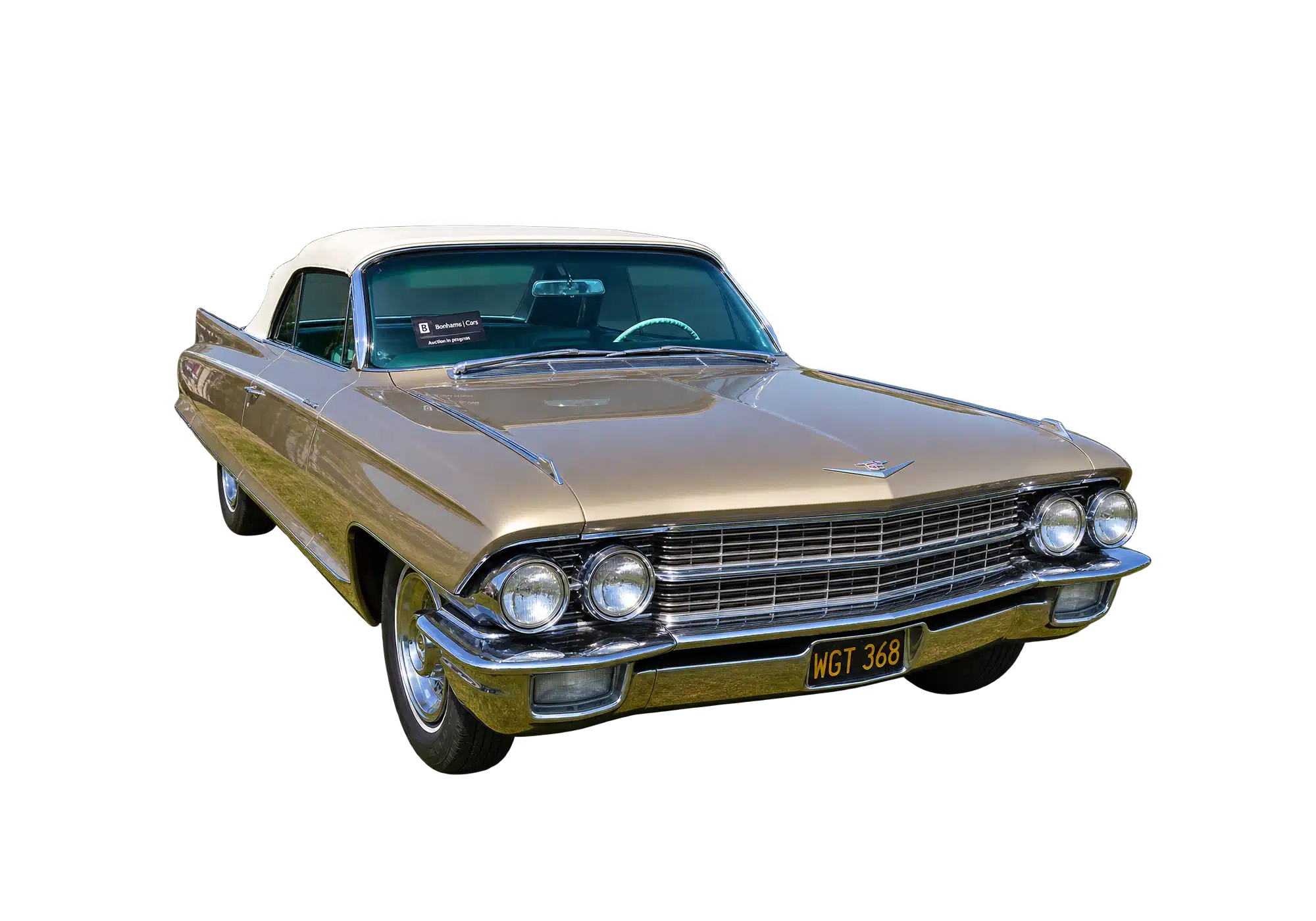
The Cadillac Eldorado, introduced in 1953, was one of America’s most prestigious luxury automobiles and a showcase for Cadillac’s styling, engineering and technological ambitions. Originally a limited-production convertible, the Eldorado evolved into a family of flamboyant hardtops, exclusive four-door sedans, powerful personal luxury coupes and front-wheel-drive convertibles. Throughout the 1950s, 1960s and 1970s, it represented some of the most extravagant automotive design Detroit ever produced.
The Eldorado’s history is unusually diverse. Early examples were rear-wheel-drive luxury cars with enormous tailfins and powerful V8 engines, while the completely redesigned 1967 Eldorado introduced front-wheel drive and a sharply styled personal luxury coupe body. The 1971–78 models became some of the largest front-wheel-drive automobiles ever manufactured, and the downsized 1979–85 generation introduced new technology alongside several troublesome engine designs.
The most historically significant versions include the original 1953 Eldorado convertible, the 1956–60 Seville and Biarritz, the exceptionally rare 1957–60 Eldorado Brougham, the dramatic 1959 Eldorado, the first front-wheel-drive 1967 Eldorado, and the final full-size 1976 Eldorado convertible. Later models, including the 1984–85 convertibles and the substantially downsized 1986–89 coupes, represent important changes in Cadillac’s approach to personal luxury.

1953 Cadillac Eldorado convertible, from an auction in Fort Worth on May 2nd, 2015
Origins: The 1953 Cadillac Eldorado
The Eldorado originated as a production version of a Cadillac show car displayed during General Motors’ 1952 show-car program and 1953 Motorama exhibition. The concept was intended to demonstrate Cadillac’s styling leadership and explore features that might appear on future production models.
The production 1953 Eldorado was introduced as a limited-edition convertible based on Cadillac’s Series 62 platform. It featured a distinctive wraparound windshield, cut-down beltline, special bodywork and a metal boot cover that concealed the folded convertible top.
Power came from Cadillac’s 331-cubic-inch overhead-valve V8, producing approximately 210 horsepower and driving the rear wheels through a Hydra-Matic automatic transmission.
Only 532 examples were produced, making the inaugural Eldorado one of the rarest regular-production Cadillacs of the postwar era.
The 1953 Eldorado was priced at approximately $7,750, substantially more than a conventional Series 62 convertible. Its exclusivity, distinctive styling and connection to GM’s Motorama program established the Eldorado as Cadillac’s most glamorous model.

1955 Cadillac Eldorado convertible, from an auction in Scottsdale on March 20th, 2021
The 1954–55 Eldorado
For 1954, Cadillac redesigned the Eldorado to share more body components with the standard Series 62 convertible. This reduced production costs and allowed Cadillac to offer the model at a substantially lower price.
Although less exclusive than the 1953 version, the 1954 Eldorado retained distinctive styling features, including special rear-quarter trim and unique exterior ornamentation.
The 331-cubic-inch V8 continued, with output increased to approximately 230 horsepower.
For 1955, Cadillac introduced a more distinctive rear-end treatment with pronounced tailfins and unique taillight assemblies. The Eldorado also received an uprated V8 producing approximately 270 horsepower through dual four-barrel carburetors.
The 1955 model established a styling direction that would become increasingly dramatic during the remainder of the decade.

1956 Cadillac Eldorado Biarritz convertible, from an auction in Hershey on October 9th, 2024
The 1956 Eldorado Seville and Biarritz
The Eldorado range expanded significantly for 1956 with the introduction of two distinct body styles.
The Eldorado Seville was a two-door hardtop coupe, while the Eldorado Biarritz continued as the convertible. These names distinguished the body styles rather than separate mechanical models. Both used Cadillac’s enlarged 365-cubic-inch V8, with Eldorado-specific tuning producing approximately 305 horsepower.
The cars featured distinctive rear styling, extensive chrome trim and luxurious interiors. The Seville offered the appearance and prestige of the Eldorado with the greater practicality of a fixed roof.
The 1956 models established the Seville and Biarritz names that would remain important throughout the late 1950s. The Biarritz name later returned as a luxury trim designation on front-wheel-drive Eldorados.

1957 Cadillac Eldorado Seville 2-dr hard top, from an auction in Greenwich on June 4th, 2023
The 1957–58 Eldorado Seville and Biarritz
The 1957 Eldorado introduced substantially revised styling, including dramatic rear-quarter panels and a more sculpted body.
The Seville hardtop and Biarritz convertible used the 365-cubic-inch V8, with output increased to approximately 325 horsepower. For 1958, Cadillac introduced a tri-power (three two-barrel carburetors) setup on the Eldorado 365 V8, raising output to 335 hp (and 335 hp was also standard in the 1958 Eldorado Brougham). The cars incorporated Cadillac’s new X-frame chassis architecture, while their lower, longer bodies emphasized the company’s increasingly extravagant styling direction.
For 1958, Cadillac introduced quad headlights and revised exterior ornamentation. The Eldorado’s distinctive rear styling continued to distinguish it from less expensive Cadillac models. These cars combined powerful V8 performance with the elaborate chrome, tailfins and luxury equipment that characterized American automotive design during the late 1950s.

1958 Cadillac Eldorado Brougham sedan, from an auction at The Quail on August 15th, 2025
The 1957–58 Eldorado Brougham
The Eldorado Brougham was one of the most extraordinary luxury automobiles Cadillac ever produced. Introduced in 1957, it was a hand-assembled, four-door pillarless hardtop with rear-hinged rear doors, a brushed stainless-steel roof and a remarkably comprehensive list of standard equipment.
The Brougham featured air suspension, automatic door locks, power memory seats, forged aluminum wheels and a specially appointed interior. Its equipment included elaborate personal accessories and vanity items that reflected Cadillac’s emphasis on luxury.
The 1957 model used a 365-cubic-inch V8 producing approximately 325 horsepower, while the 1958 version received additional engine refinements.
The Brougham cost approximately $13,000, making it more expensive than many contemporary European luxury automobiles. Cadillac produced 400 examples in 1957 and 304 in 1958, for a total of 704 Detroit-built Broughams.
Their specialized bodywork, unusual equipment and limited production make them particularly challenging to restore correctly. The stainless-steel roof, air suspension and original interior accessories are especially important when evaluating surviving cars.

1959 Cadillac Eldorado Biarritz convertible, from an auction at The Quail on August 15th, 2025
The 1959 Eldorado: Cadillac’s Most Dramatic Tailfins
The 1959 Eldorado represents the peak of Cadillac’s flamboyant late-1950s styling. Its enormous tailfins, twin bullet-shaped taillights, expansive chrome trim and low, wide body created one of the most recognizable designs in American automotive history.
The Seville hardtop and Biarritz convertible used Cadillac’s enlarged 390-cubic-inch V8, with Eldorado-specific versions producing approximately 345 horsepower. The cars featured extensive luxury equipment and elaborate interiors, with distinctive exterior ornamentation separating them from ordinary Cadillac models.
The 1959 Eldorado was also offered with air suspension, although many surviving cars have subsequently been converted to conventional springs because of maintenance difficulties. The Biarritz convertible is especially recognizable because its dramatic tailfins and open body capture the styling excesses of the era.
The 1959–60 Eldorado Brougham by Pininfarina
For 1959, Cadillac introduced a completely redesigned Eldorado Brougham with bodywork manufactured by Pininfarina in Italy.
Unlike the 1957–58 Detroit-built Brougham, the new version featured a more restrained four-door hardtop body with a distinctive roofline and cleaner styling. Bodies were constructed in Italy and shipped to the United States for final assembly and completion.
The 1959 Brougham used Cadillac’s 390-cubic-inch V8, while the 1960 model received additional mechanical and styling refinements. Only 99 examples were produced for 1959 and 101 for 1960, making the Italian-bodied Brougham even rarer than its Detroit-built predecessor.
The Pininfarina Brougham is important because it represents a rare collaboration between Cadillac and a major European coachbuilder. Its specialized body panels, glass, trim and interior components require exceptional care during restoration.

1960 Cadillac Eldorado Biarritz convertible, from an auction on Amelia Island on March 6th, 2019
The 1960 Eldorado Seville and Biarritz
The 1960 Eldorado retained much of the 1959 car’s basic body architecture but adopted a more restrained rear-end treatment. The towering 1959 fins were reduced in height, and the taillights were redesigned to create a cleaner appearance.
The Seville hardtop and Biarritz convertible continued with the 390-cubic-inch V8, producing approximately 345 horsepower in Eldorado specification. These were the final Eldorados to use the Seville and Biarritz names as separate hardtop and convertible body styles during the original rear-wheel-drive era.
The 1960 cars offer much of the visual drama of the 1959 models, but with somewhat less extravagant styling.

1961 Cadillac Eldorado Biarritz resto-mod convertible, from an auction on February 20th, 2025
The 1961–62 Eldorado Biarritz
For 1961, Cadillac simplified the Eldorado range, eliminating the Seville hardtop and retaining only the convertible. The Eldorado continued to carry the Biarritz name, although the distinction became less significant because there was no longer a corresponding Eldorado hardtop. The 1961 model featured a completely redesigned body with smaller tailfins, a cleaner front end and a more restrained appearance.
The 390-cubic-inch V8 continued, producing approximately 325 horsepower in standard Cadillac specification. For 1962, the Eldorado received revised exterior styling and additional luxury equipment.
These models represent a transitional period between the flamboyant late-1950s Eldorados and the more formal Cadillac designs of the mid-1960s.

1964 Cadillac Eldorado convertible, from an auction in Auburn on September 3rd, 2016
The 1963–64 Eldorado
The 1963 Eldorado adopted sharper, more formal styling, with flatter body surfaces and a revised front end. Cadillac retained the 390-cubic-inch V8 for 1963, while the 1964 model received a new 429-cubic-inch V8 producing approximately 340 horsepower. The 1964 Eldorado also benefited from Cadillac’s updated Turbo Hydra-Matic automatic transmission.
During this period, the Eldorado remained a luxury convertible closely related to Cadillac’s regular full-size models, rather than the distinct personal luxury car it would become in 1967. The 1963–64 cars are notable for their restrained styling, substantial V8 power and relatively conventional mechanical layout.

1966 Cadillac Eldorado convertible, from an auction on March 11, 2021
The 1965–66 Fleetwood Eldorado
For 1965, the Eldorado became part of Cadillac’s Fleetwood series, emphasizing its position near the top of the company’s model range. The body was redesigned with a longer, lower appearance, vertically arranged headlights and more formal rear styling.
The 429-cubic-inch V8 continued, producing approximately 340 horsepower. The 1966 Fleetwood Eldorado was the final rear-wheel-drive Eldorado convertible before the introduction of the completely redesigned front-wheel-drive coupe. These cars retained traditional Cadillac body-on-frame construction, rear-wheel drive and large V8 engines.
The 1966 Eldorado is particularly significant as the final example of the original rear-wheel-drive convertible lineage.
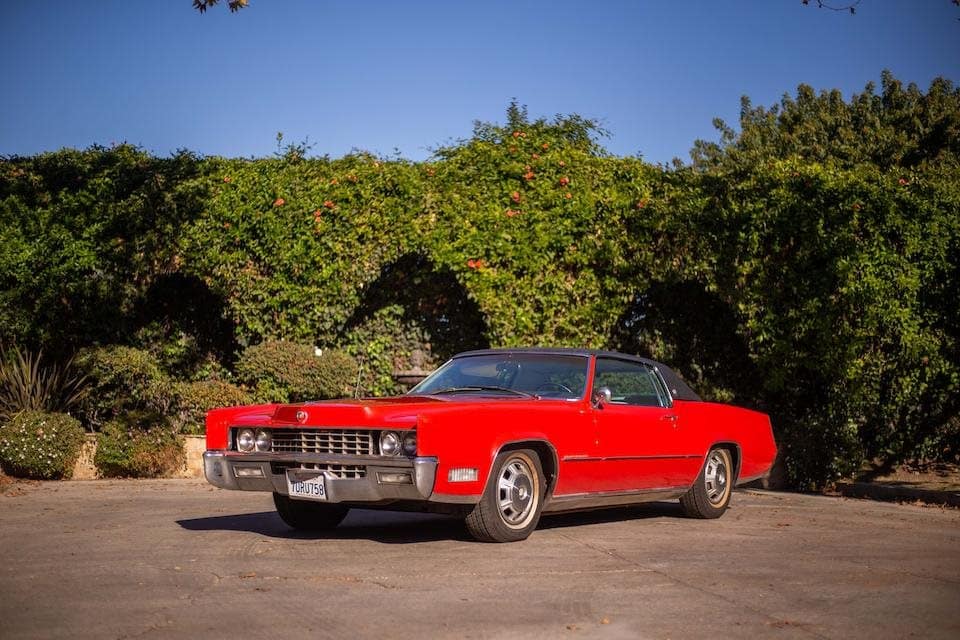
1967 Cadillac Eldorado 2-dr hard top, from an auction in Scottsdale on January 21st, 2021
The Revolutionary 1967 Front-Wheel-Drive Eldorado
The 1967 Eldorado represented the most important transformation in the model’s history. Cadillac abandoned the conventional rear-wheel-drive convertible layout and introduced a completely new front-wheel-drive personal luxury coupe. The car shared its basic front-wheel-drive architecture with the Oldsmobile Toronado but featured distinctive Cadillac engineering and styling.
Its dramatic body was developed under the direction of Bill Mitchell, with major design contributions from Chuck Jordan and Cadillac’s styling staff. The long hood, sharply defined fenders, hidden headlights and fastback roofline created a striking appearance that differed substantially from contemporary Cadillac sedans. Power came from Cadillac’s 429-cubic-inch V8, producing approximately 340 horsepower, coupled to a specially adapted Turbo Hydra-Matic automatic transaxle.
The 1967 Eldorado was praised for its combination of performance, luxury and distinctive styling. It established the front-wheel-drive configuration that would define the model for the remainder of its production life.

1969 Cadillac Eldorado 2-dr hard top, from an online auction on July 12th, 2021
The 1968–70 Eldorado
The 1968 Eldorado received Cadillac’s new 472-cubic-inch V8, producing approximately 375 gross horsepower. The larger engine provided exceptional torque, making the heavy front-wheel-drive coupe capable of impressive acceleration.
Styling changes were relatively modest, preserving the sharp lines and hidden headlights of the original 1967 design.
For 1969, Cadillac introduced additional styling and equipment revisions, including a redesigned grille and revised rear-end treatment. The 1970 Eldorado received an even larger 500-cubic-inch V8, producing approximately 400 gross horsepower and 550 lb-ft of torque. At 8.2 liters, the 500 was one of the largest engines ever installed in a regular-production American passenger car.
The 1967–70 Eldorados combined distinctive styling, enormous V8 torque and relatively sophisticated front-wheel-drive engineering, making them among the most engaging Eldorados to drive.

1971 Cadillac Eldorado convertible, from an auction in Carson City on August 12th, 2012
The 1971 Eldorado Redesign
Cadillac introduced a completely redesigned Eldorado for 1971, creating a larger and more formal personal luxury car. The new body featured a longer hood, more upright grille, pronounced rear fenders and substantial chrome trim.
Most importantly, the Eldorado convertible returned after a four-year absence. Both the coupe and convertible used the front-wheel-drive drivetrain and Cadillac’s 500-cubic-inch V8.
The 1971 Eldorado was one of the largest front-wheel-drive automobiles ever produced, combining an enormous engine with substantial weight and luxury equipment. Its styling and proportions reflected the American preference for large personal luxury cars during the early 1970s.

1972 Cadillac Eldorado coupe, from an auction on November 21st, 2025
The 1972–74 Eldorado
The 1972 Eldorado retained the 1971 design but incorporated revisions to exterior trim, interior equipment and emissions-related engine specifications. Horsepower ratings declined substantially during this period, partly because of the industry-wide transition from gross to SAE net horsepower measurements and increasingly restrictive emissions requirements. The 500-cubic-inch V8 continued to provide substantial torque, even as its published horsepower figures fell.
For 1973, Cadillac revised the grille, bumpers and rear styling. The 1974 Eldorado received additional changes, including larger federally mandated impact-resistant bumpers and revised exterior trim. These cars remained exceptionally large and comfortable, emphasizing effortless cruising rather than sporting handling.

1976 Cadillac Eldorado Biarritz convertible, from an auction on April 12th, 2019
The 1975–76 Eldorado Convertible
The 1975–76 Eldorado convertible became one of the most recognizable American luxury cars of the decade. The 1975 model introduced revised styling with a more formal front end, rectangular headlights and updated rear-quarter panels. The 500-cubic-inch V8 remained standard, although emissions controls reduced output to approximately 190 horsepower in 1975.
For 1976, Cadillac announced that the Eldorado would be its final factory-produced convertible, reflecting industry expectations that safety regulations would make open cars impractical. The announcement generated considerable publicity and increased demand.
The 1976 Eldorado convertible was offered in a special Bicentennial Edition, featuring white paint, red-and-white interior trim and commemorative details. Cadillac built 14,000 Eldorado convertibles for 1976, including 200 Bicentennial Edition cars.
Although Cadillac later resumed convertible production, the 1976 model remains historically important because it marked the end of the traditional full-size American luxury convertible era.

1977 Cadillac Eldorado coupe, from an auction on February 23rd, 2023
The 1977–78 Eldorado
For 1977, Cadillac discontinued the Eldorado convertible and continued with the two-door coupe. The 500-cubic-inch V8 was replaced by a smaller 425-cubic-inch V8, producing approximately 180 horsepower. The change reflected increasing pressure to improve fuel economy and meet emissions requirements.
Styling changes were relatively minor, with revised grilles, trim and equipment. The 1978 Eldorado was the final version of the large 1971–78 body design.
These cars retained the traditional American luxury-car characteristics of substantial size, soft suspension and effortless V8 cruising, but they were approaching the end of an era as Cadillac prepared a smaller replacement.
The Downsized 1979 Eldorado
The 1979 Eldorado introduced a substantially smaller and lighter body, marking another major change in the model’s development. The new car shared its basic platform with the Buick Riviera and Oldsmobile Toronado. Although shorter and lighter than its predecessor, it retained front-wheel drive, a formal personal luxury coupe body and extensive comfort equipment.
The 1979 Eldorado used an Oldsmobile-built 350-cubic-inch gasoline V8 as its standard engine. A 350-cubic-inch diesel V8 was also available, reflecting General Motors’ efforts to improve fuel economy during a period of rising gasoline prices. In California, emissions regulations required Cadillac to substitute its own 368-cubic-inch fuel-injected V8 a year early in 1979 before rolling it out nationwide for 1980.
The new Eldorado introduced independent rear suspension and four-wheel disc brakes, providing improved handling and braking compared with the earlier full-size models.

1984 Cadillac Eldorado Biarritz convertible, from an auction on April 24th, 2026
The Eldorado Biarritz: 1979–85
Cadillac revived the Biarritz name for a luxury trim package on the downsized Eldorado. The Biarritz featured distinctive exterior ornamentation, upgraded interiors and additional luxury equipment. One of its most recognizable features was a brushed stainless-steel roof section, recalling the original Eldorado Brougham of the late 1950s.
Many Biarritz models also featured padded vinyl roof treatments, special wheel covers and distinctive interior materials. The Biarritz emphasized traditional Cadillac luxury rather than performance.
Today, original examples with complete stainless-steel trim, correct roof treatments and well-preserved interiors are particularly interesting because these components can be difficult to restore or replace.
The 1980 Eldorado and 368 V8
For 1980, Cadillac replaced the standard gasoline 350 V8 in most markets with its own 368-cubic-inch V8. The engine displaced approximately 6.0 liters and incorporated electronic fuel injection. The 368 was derived from Cadillac’s earlier large-displacement V8 family and provided strong low-speed torque.
The diesel V8 remained available, although its reliability problems were becoming increasingly apparent. The 1980 Eldorado retained the styling and chassis introduced in 1979, with relatively minor equipment changes.
The 1981 Eldorado V8-6-4
The 1981 Eldorado introduced Cadillac’s controversial V8-6-4 variable-displacement engine. Based on the 368-cubic-inch V8, the system used electronic controls to deactivate cylinders under light-load conditions. Depending on driving requirements, the engine could operate on eight, six or four cylinders. The objective was to improve fuel economy without sacrificing the smoothness and torque of a large V8.
Unfortunately, the electronics and control systems were not sufficiently developed for consistent real-world operation. Many owners experienced hesitation, inconsistent performance and drivability problems, leading some cars to have the cylinder-deactivation system disabled.
The V8-6-4 was an important early attempt at a technology that later became common, but its original implementation damaged Cadillac’s reputation for mechanical reliability.
The 1982–85 Eldorado HT4100
For 1982, Cadillac introduced the HT4100, a new 4.1-liter V8 intended to improve fuel economy and reduce weight. The engine used an aluminum block with cast-iron cylinder heads and electronic fuel injection. Although technologically ambitious, the HT4100 developed a reputation for serious reliability problems. Common failures included coolant leaks, head-gasket problems, bearing damage and deterioration associated with the interaction between aluminum and iron components.
The engine also produced substantially less torque than the earlier Cadillac V8s, making the heavy Eldorado feel less powerful. Cadillac introduced improvements during production, but the HT4100 remains one of the most important concerns when evaluating an early-1980s Eldorado.
The 1982–85 cars are otherwise comfortable and distinctive luxury coupes, particularly in Biarritz specification.
The 1984–85 Eldorado Convertible
Cadillac returned to convertible production for 1984, introducing a factory-authorized Eldorado convertible built through a conversion program involving American Sunroof Corporation. The cars began as Eldorado coupes and were converted into open models with reinforced body structures and folding tops. The convertible was available for 1984 and 1985, making these cars relatively uncommon compared with the regular coupes. They retained the standard HT4100 V8 and front-wheel-drive drivetrain.
The 1984–85 Eldorado convertibles are historically interesting because they marked Cadillac’s return to open-car production after the heavily publicized discontinuation of the 1976 convertible. However, the conversion-specific body components, roof mechanisms and weather seals can be difficult to repair.
The 1986 Eldorado Redesign
The 1986 Eldorado underwent another dramatic downsizing, becoming substantially shorter, narrower and lighter. The new body featured a more compact, formal design with a sharply defined roofline and restrained exterior ornamentation.
Unlike earlier Eldorados, the 1986 model used a transversely mounted V8 engine and a more compact front-wheel-drive drivetrain layout. The standard engine remained the 4.1-liter HT4100, producing approximately 130 horsepower.
The car retained independent suspension, four-wheel disc brakes and extensive luxury equipment. However, the smaller body and conservative styling disappointed some traditional Cadillac buyers, and Eldorado sales declined sharply.
The 1986 redesign marked a significant departure from the large, imposing personal luxury coupes that had defined the model during the previous two decades.
The 1987–89 Eldorado
The 1987 Eldorado continued with relatively minor changes, retaining the compact body and HT4100 V8. For 1988, Cadillac introduced a larger 4.5-liter V8, producing approximately 155 horsepower. The new engine offered improved torque and drivability compared with the HT4100.
The 1988 Eldorado also received styling revisions intended to give the car a more substantial appearance. For 1989, Cadillac continued refining the design, adding equipment and making further improvements to the drivetrain and interior.
Although these cars lacked the visual drama and imposing dimensions of earlier Eldorados, they represented Cadillac’s attempt to adapt the personal luxury coupe to changing market conditions.
Major Eldorado Engines Through 1989
| Model years | Engine | Approximate output |
|---|---|---|
| 1953 | 331-cid V8 | 210 hp |
| 1954–55 | 331-cid V8 | 230–270 hp |
| 1956–58 | 365-cid V8 | 305–335 hp |
| 1959–63 | 390-cid V8 | 325–345 hp |
| 1964–67 | 429-cid V8 | 340 hp |
| 1968–69 | 472-cid V8 | 375 gross hp |
| 1970–76 | 500-cid V8 | 190 net–400 gross hp |
| 1977–78 | 425-cid V8 | Approximately 180 hp |
| 1979 | Oldsmobile 350-cid gasoline V8 | Approximately 170 hp |
| 1979–85 | Oldsmobile 350-cid diesel V8, optional | Approximately 105–125 hp |
| 1980–81 | Cadillac 368-cid V8 | Approximately 140–145 hp |
| 1982–87 | Cadillac HT4100 4.1-liter V8 | Approximately 125–135 hp |
| 1988–89 | Cadillac 4.5-liter V8 | Approximately 155 hp |
Horsepower figures are approximate and vary by model year, market and engine specification. Ratings before 1972 generally use SAE gross horsepower, while later figures use SAE net horsepower, so the numbers are not directly comparable.
Understanding the Major Cadillac Eldorado Variants
- 1953 Eldorado Convertible: Original limited-production Motorama-inspired model, with 532 built.
- 1954–55 Eldorado Convertible: Revised Series 62-based luxury convertible with distinctive trim and styling.
- 1956–60 Eldorado Seville: Two-door hardtop coupe offered alongside the Biarritz convertible.
- 1956–60 Eldorado Biarritz: Luxury convertible with distinctive exterior ornamentation and high-output V8 engines.
- 1957–58 Eldorado Brougham: Hand-built four-door hardtop with stainless-steel roof, air suspension and extensive luxury equipment.
- 1959–60 Pininfarina Eldorado Brougham: Italian-bodied four-door luxury hardtop, with only 200 produced.
- 1961–66 Eldorado Convertible: Final rear-wheel-drive Eldorado convertibles, with Fleetwood designation from 1965.
- 1967–70 Fleetwood Eldorado: First front-wheel-drive generation, including the powerful 472- and 500-cubic-inch versions.
- 1971–76 Eldorado Convertible: Large front-wheel-drive convertible, culminating in the heavily publicized 1976 final-year model.
- 1976 Eldorado Bicentennial Edition: Special commemorative convertible, with 200 produced.
- 1977–78 Eldorado Coupe: Final versions of the large 1971–78 body design, using the 425-cubic-inch V8.
- 1979–85 Eldorado Coupe: Downsized front-wheel-drive model with revised chassis and multiple engine options.
- 1979–85 Eldorado Biarritz: Luxury trim package featuring distinctive roof treatments and upgraded equipment.
- 1981 Eldorado V8-6-4: Variable-displacement V8 model with early electronic cylinder-deactivation technology.
- 1984–85 Eldorado Convertible: Factory-authorized convertible conversion based on the downsized coupe.
- 1986–89 Eldorado Coupe: Smaller transverse-engine front-wheel-drive model, initially with the HT4100 and later the 4.5-liter V8.
Important Sales Reviewed by SCM Experts
In each month’s issue for the past 38 years, SCM’s analysts have reviewed 5 to 7 significant cars sold at auction, and discuss what options, history, or details made that particular more or less valuable. They give their expert opinion on the market for these cars, and whether this car was well bought or well sold. If you’re thinking of purchasing a Cadillac Eldorado, you’ll likely find these profiles critical in helping you make the right decision. Each of the following is an article from our print magazine on a Cadillac Eldorado sold at auction.
 1976 Cadillac Eldorado ConvertibleA fair price for an “instant collectible” approaching its 50th birthday When Cadillac announced that 1976 would be the last year of the convertible Cadillacs, there was an instant increase in demand, and production went up by 156% compared to the year before. The convertible was reintroduced in 1984, but it never became the same […]Read more
- 1964 Cadillac Eldorado ConvertibleA largely original example, this 1964 Cadillac Eldorado convertible was sold new on May 7, 1964, at Smith Motors Company — Cadillac Motor Cars in Elizabeth, NJ. This example would reside with the original family until 1998, when a collector of Cadillacs purchased it. The car was rarely driven by Mrs. Valiant, the original owner, and […]Read more
- 1959 Cadillac Eldorado BiarritzAs Cadillac’s designers opted for more-restrained styling for 1960, the single-model-year styling of the 1959 Cadillacs has made those cars a true icon of the era. One of only 1,320 Eldorado Biarritz convertibles produced in 1959, this Eldorado Biarritz was one of the most expensive cars of its era and remains a highly coveted example […]Read more
- 1957 Cadillac Eldorado BroughamBy the 1950s, Cadillac had firmly established its reputation as the “Standard of the World”; its stylish, advanced vehicles conveyed heads of state and leading entertainers alike, and they were eagerly sought by members of the social and economic elite. What, then, did the marque have to prove? Apparently, Cadillac brass felt some sort of […]Read more
 1959 Cadillac Eldorado BiarritzOne of 1,320 produced Height of the era’s design Striking black-and-red color combo 345-hp Tri-Power 390-ci V8 High-tech features By the late 1950s, Cadillac reigned supreme over the full-sized luxury-car market in North America with exciting products that featured advanced engineering and the leading-edge styling of Harley Earl. While the 1959 Eldorado was controversial and […]Read more


Cars For Sale
Quick links to listings for this make and model online:
Books on the Cadillac Eldorado


Note that as an Amazon Associate, we earn from qualifying purchases of the above books.
Past Auction Sales – Cadillac Eldorado
Average Cadillac Eldorado Sale Price by Year from SCM’s Platinum Auction Database:
Includes sales listed as Cadillac Eldorado Brougham, Cadillac Eldorado Biarritz, Cadillac Eldorado Seville.
Cadillac Eldorado Sales from SCM’s Platinum Auction Database:

RM Sotheby's
Condition: 3+
Oct 7, 2026
$494,500

RM Sotheby's
Condition: 2+
Oct 7, 2026
$207,200

Bonhams
Condition: 3
Aug 13, 2026
$40,320

GAA Classic Cars
Condition: 3+
Jul 23, 2026
$52,380

Bonhams Cars
Condition: 1-
May 31, 2026
$56,000

Kruse Auctions
Condition: 3+
Apr 24, 2026
$17,920

McCormick's
Condition: 2-
Feb 20, 2026
$19,080

Bring a Trailer
Condition: 3-
Feb 10, 2026
$74,550

Hagerty Marketplace
Condition: 2-
Jan 30, 2026
$11,530

Bonhams Cars
Condition: 2+
Jan 23, 2026
$106,400

McCormick's
Condition: 3
Nov 21, 2025
$6,360

Saratoga Motorcar Auctions
Condition: 1-
Sep 19, 2025
$187,000

Bonhams Cars
Condition: 3+
Aug 15, 2025
$100,800

Bonhams Cars
Condition: 3
Aug 15, 2025
$162,400

Bring a Trailer
Condition: 2
Jul 30, 2025
$60,900

GAA Classic Cars
Condition: 2-
Jul 24, 2025
$118,800

GAA Classic Cars
Condition: 1-
Jul 24, 2025
$70,400

Bring a Trailer
Condition: 3
Jul 9, 2025
$96,075

GAA Classic Cars
Condition: 1-
Feb 20, 2025
$231,120

Bring a Trailer
Condition: 2+
Feb 10, 2025
$147,000

RM Sotheby's
Condition: 2-
Jan 24, 2025
$190,400

Broad Arrow Auctions
Condition: 1-
Oct 12, 2024
$291,000

RM Sotheby's
Condition: 2+
Oct 9, 2024
$209,000

Bonhams Cars
Condition: 2
Aug 16, 2024
$235,000

Bring a Trailer
Condition: 1-
Aug 12, 2024
$212,500

Gooding & Co.
Condition: 2+
Feb 29, 2024
$95,200

Worldwide Auctioneers
Condition: 3
Jan 26, 2024
$73,920

GAA Classic Cars
Condition: 2
Nov 2, 2023
$54,000

Bonhams Cars
Condition: 5-
Oct 17, 2023
$8,478

RM Sotheby's
Condition: 4+
Oct 4, 2023
$46,750

RM Sotheby's
Condition: 3+
Oct 4, 2023
$101,750

Broad Arrow Auctions
Condition: 2
Aug 17, 2023
$400,000

Bonhams Cars
Condition: 3+
Jun 18, 2023
$105,842

Bonhams Cars
Condition: 2
Jun 4, 2023
$45,920

Hemmings
Condition: 3+
Apr 19, 2023
$120,915

Hemmings
Condition: 3+
Mar 11, 2023
$23,100

GAA Classic Cars
Condition: 3+
Feb 23, 2023
$15,120

Sullivan Auctioneers
Condition: 3
Feb 20, 2023
$16,000

Bonhams
Condition:
Jan 27, 2023
$117,600

RM Sotheby's
Condition: 2-
Jan 26, 2023
$224,000

RM Sotheby's
Condition: 2-
Jan 26, 2023
$84,000

Bring a Trailer
Condition: 3
Dec 6, 2022
$49,350

McCormick's
Condition: 2+
Nov 18, 2022
$42,930

Hemmings
Condition: 3+
Nov 14, 2022
$84,000

Broad Arrow Auctions
Condition: 2
Aug 18, 2022
$224,000

Bonhams
Condition: 2
Jun 5, 2022
$104,160

Barrett-Jackson
Condition: 2+
Apr 9, 2022
$115,500

RM Sotheby's
Condition: 2-
Mar 5, 2022
$250,000

Gooding & Co.
Condition: 2-
Jan 28, 2022
$121,000

MAG Auctions
Condition: 2-
Jan 27, 2022
$95,040
See all 79 sales in SCM’s Platinum auction database: Cadillac Eldorado · Cadillac Eldorado Brougham · Cadillac Eldorado Biarritz · Cadillac Eldorado Seville
Forums & Communities
Popular Videos about the Cadillac Eldorado


