Accident reconstruction can establish the truth after a car collision This month’s “Legal Files” brings back memories for both me and Publisher Martin. We were born three months apart and grew up on opposite sides of Golden Gate Park in San Francisco, in the area known as “The Avenues.” We went to rival high schools, and we both ended up in Portland, where we met and became fast friends some 35 years ago. The Avenues were laid out in a rigid grid pattern. The non-arterial intersections were totally unprotected, and car crashes were a common occurrence. We’d hear a skid, then a loud crash, and we’d run outside to see how mangled the cars were. Today, stop signs and traffic signals have largely solved the problem, but not entirely. Non-stop “Tom” was driving his Honda SUV, descending Potrero Hill’s roughly 20% grade. When he came to the intersection at the bottom, he saw that the traffic signals were inoperative, making it a four-way stop. Tom stopped, did not see any cross traffic, and started off. He made it to the middle of the intersection when he was broadsided by a Porsche Cayenne driven by “Hurley” that entered the intersection from his right without stopping. The considerable force of the impact pushed Tom about 40 feet away and rolled his Honda onto its top. As we know, there are always at least two sides to every story. Hurley told a similar story, except the roles were reversed. He stopped completely at the intersection, checked for cross traffic, accelerated, and then was surprised as Tom failed to stop and appeared in his path, leaving him no time to stop. Lawsuit filed Tom was injured and filed suit to recover damages for his medical injuries and the damage to the Honda. Hurley was incredulous that he was being sued, as the crash was all Tom’s fault. Lawyer SCMers know that litigants often have wildly different versions of what happened. Witnesses can be helpful in establishing who did what; unfortunately, we didn’t have any here. Physical evidence can be critical and decisive, but there…
Accident reconstruction can establish the truth after a car collision
This month’s “Legal Files” brings back memories for both me and Publisher Martin. We were born three months apart and grew up on opposite sides of Golden Gate Park in San Francisco, in the area known as “The Avenues.” We went to rival high schools, and we both ended up in Portland, where we met and became fast friends some 35 years ago.
The Avenues were laid out in a rigid grid pattern. The non-arterial intersections were totally unprotected, and car crashes were a common occurrence. We’d hear a skid, then a loud crash, and we’d run outside to see how mangled the cars were. Today, stop signs and traffic signals have largely solved the problem, but not entirely.
Non-stop
“Tom” was driving his Honda SUV, descending Potrero Hill’s roughly 20% grade. When he came to the intersection at the bottom, he saw that the traffic signals were inoperative, making it a four-way stop. Tom stopped, did not see any cross traffic, and started off.
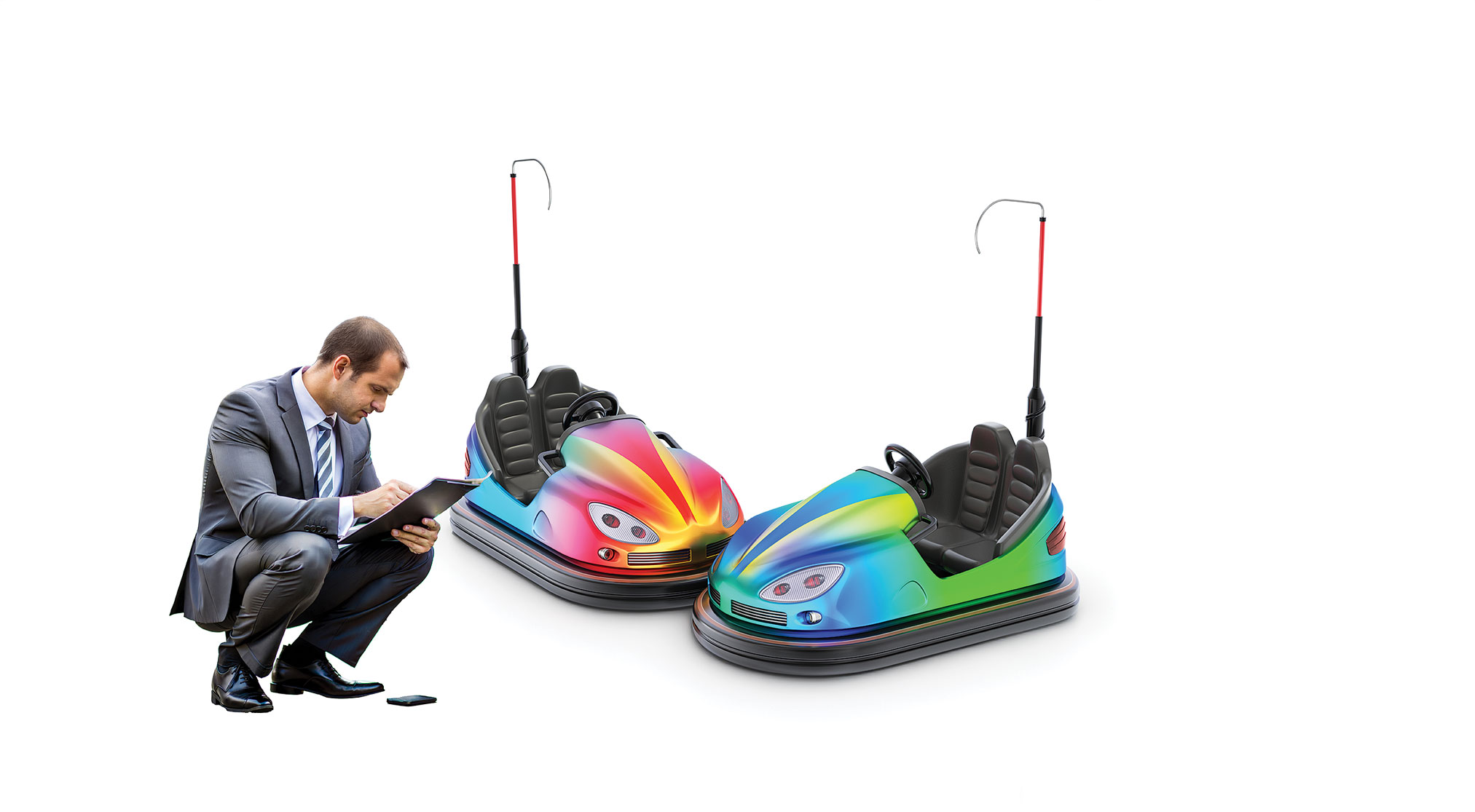
He made it to the middle of the intersection when he was broadsided by a Porsche Cayenne driven by “Hurley” that entered the intersection from his right without stopping. The considerable force of the impact pushed Tom about 40 feet away and rolled his Honda onto its top.
As we know, there are always at least two sides to every story. Hurley told a similar story, except the roles were reversed. He stopped completely at the intersection, checked for cross traffic, accelerated, and then was surprised as Tom failed to stop and appeared in his path, leaving him no time to stop.
Lawsuit filed
Tom was injured and filed suit to recover damages for his medical injuries and the damage to the Honda. Hurley was incredulous that he was being sued, as the crash was all Tom’s fault.
Lawyer SCMers know that litigants often have wildly different versions of what happened. Witnesses can be helpful in establishing who did what; unfortunately, we didn’t have any here. Physical evidence can be critical and decisive, but there wasn’t much here either. That then leaves the testimony of the litigants. The judge or jury will have to listen to them, consider their demeanor, decide which of them is more credible, and believe their side of the story.
Hurley’s lawyer was nervous about leaving the decision to a jury’s sense of which of the two parties was more believable, as that can work to the advantage of the better actor (or liar). He thought that an accident-reconstruction analysis could help prove Hurley’s story was the true one. He retained this piece’s co-author, Ed Milich, to see if accident-reconstruction science could uncover the truth about what happened.
The science
An accident-reconstruction analysis starts with evidence such as photos, traffic-collision reports, skid marks and sworn depositions to work backward and conjure out times, speeds, distances and related factual data. Ed performed an extensive site inspection and took hundreds of photos and dozens of laser scans.
This intersection, like much of modern San Francisco, was in constant flux. Paint markings, curbs and other details were continually evolving. Since the analysis was being done nearly two years after the crash, it was hard to know what the exact physical environment was at the time of the crash. Eventually, he had to use a manhole cover and a fire hydrant (both stationary for over half a century) as references.
Ed’s team used photogrammetry to reconcile photos with measurements and generate an accurate digital scene model. One given was the Honda’s resting place after the rollover. Using skid and gouge-mark lengths along with known friction values of a skidding tire and an SUV rolling over on dry pavement, the point of impact (POI) and the pre-impact velocities were found. Ed calculated that the Honda traveled 58 feet and the Porsche traveled 52 feet from each limit line to the POI. Just before impact, the Honda was estimated to be traveling at 20 to 30 mph and the Porsche at 17 to 22 mph.
Maximum acceleration rates are known from published data. The Porsche’s acceleration made sense, but the Honda’s didn’t. Its maximum acceleration was 0.38 g/sec. In fact, getting to 25 mph in 58 feet required all of its potential acceleration, but that wasn’t the mild acceleration Tom swore to. Achieving that speed in that distance required a pedal-to-the-metal race start.
It was concluded that the Porsche traversed the 52-feet distance in three to four seconds. But the Honda traversed its 58 feet in about half this time. It could only have done that by blowing the stop sign. By failing to stop before entering the intersection, Tom had caused the collision and rollover.
The trial
Of course, Tom’s lawyer had retained an accident-reconstruction expert to bolster their case. Before Ed testified, he noticed the jury questioning the opposing expert’s opinions about times, distances and speeds, so he prepared for the same.
His testimony lasted for four hours, in which he used the opposing expert’s own numbers to display inconsistencies and show that their narrative of Tom stopping at the intersection was false. Ed pointed out that the opposing expert tried to fudge his numbers using arbitrary points instead of the actual limit line to begin vehicle acceleration. He also used unreasonable friction values to make the math worjk in the plaintiff’s favor, inconsistencies that were presented to the jury.
In a very satisfying end, the jury agreed with Ed’s analysis and returned a verdict for the defense within 24 hours of deliberation. Tom walked away empty-handed.
Observations
This case began with two totally different versions of what happened. They couldn’t both be correct. Either one was, or the truth was somewhere in between.
The recollections of the parties are usually suspect. There were a lot of things going on at the time, and it’s always difficult to have an objective view of what actually happened when you’re in the middle of it. It is always so easy to “remember” your perceptions of what happened as the actual facts.
Eyewitness testimony is more objective but is also subject to the same problems of perception vs. reality. After all, no one really expects to be a witness to something before it happens. You usually only see or perceive some fraction of what actually occurred. These unexpected memories can be faulty.
Enter science. Expert analysis can be unbiased and scientific; the laws of physics always apply. But as scientific as the analysis may be, the expert always has to make some assumptions and extrapolations to fill in gaps in the known facts. Opinions can legitimately differ.
Lawyers and judges know that expert testimony always has its limitations. The expert witness is supposed to be professional and objective, and to have the highest integrity. They aren’t there to advocate for the party that is paying their fees, which can often be substantial. They are supposed to assist the judge and jury in deciding the case, and that is their constituency.
However, that isn’t always how it works in the real world. Experts are expected to produce the desired results. They have a lot of incentive to come up with the answer the client wants. If they don’t, they’re probably going to be dismissed before the trial starts another expert substituted. Consequently, some experts will say outrageous things to earn their fees. Competent experts can usually uncover such chicanery, but it takes careful thought and analysis, and someone smart enough to do it on the fly.
As you may have gathered, lawsuits are not cut and dried. They are searches for the truth, but it’s often not possible to know when you have the truth. The winner is the one whose version of the truth is the more believable, in the view of the judge or the jury.

Leave a Reply