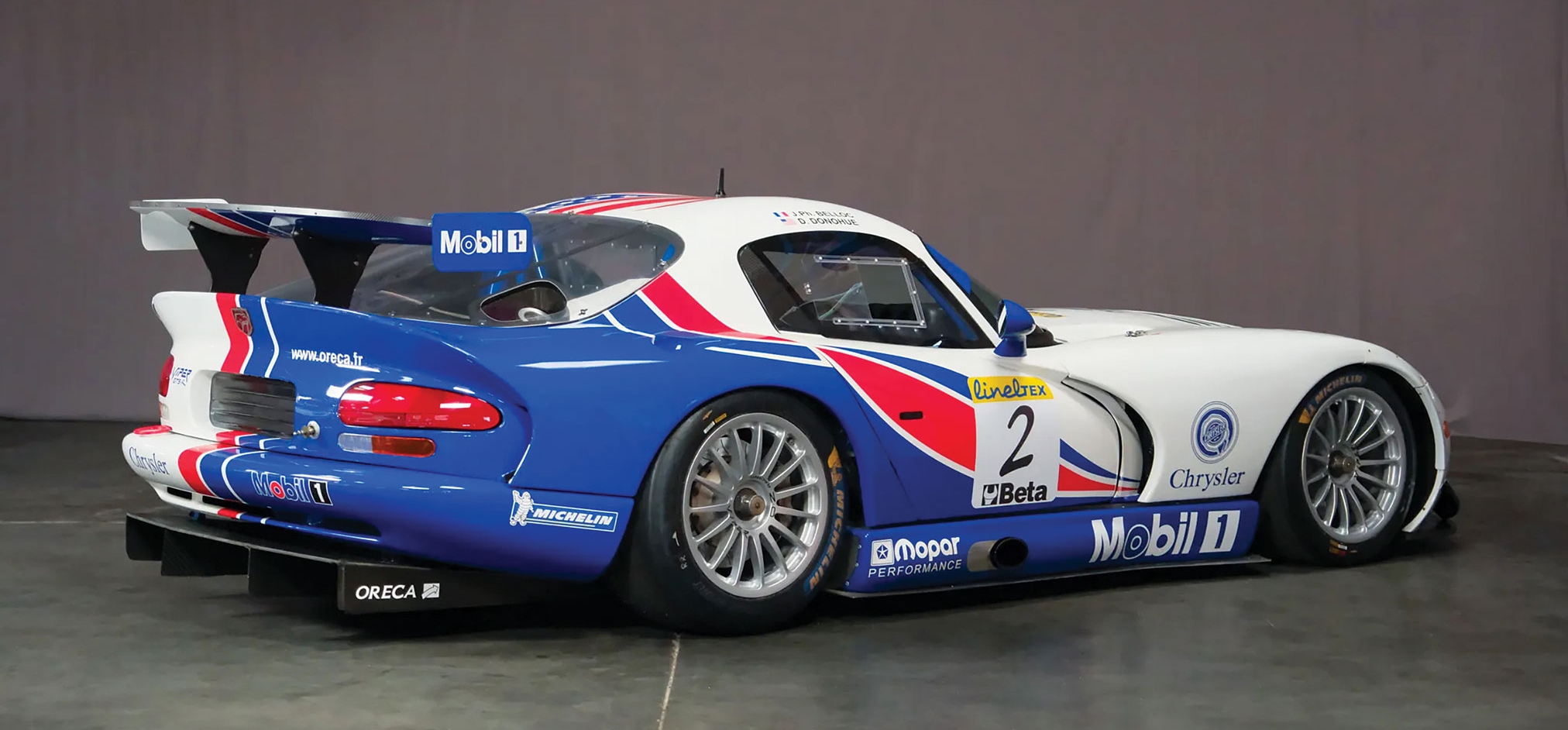
This car, Lot 234581, sold for $1,207,500, including buyer’s premium, on Bring a Trailer’s online auction on March 25, 2026.
In the late 1980s, Chrysler President Bob Lutz was looking around for ways to strengthen the company’s performance image. He settled on the idea of Chrysler creating and selling something like a more-modern 427 Cobra as a “halo” car, something to catch people’s attention. It was to be shamelessly brutal: open top, light, high horsepower and minimal comfort in service of in-your-face extreme performance. Thus, in 1992, the Dodge Viper was born.
With the 1996 model year, Chrysler updated the Viper to the SR II, making it more comfortable and user friendly, and introduced a coupe version that improved aerodynamics and stiffened the chassis, which in turn helped the handling. The Viper sold well in the U.S. and proved a formidable competitor in American racing, but was a more difficult proposition in Europe, where it was sold as a Chrysler. To raise the Viper’s profile on that side of the pond, Chrysler decided to go FIA racing.
Snake racing
The late 1990s were a time of change in international racing. The front of the GT grids were filled with manufacturer “Works” GT1 cars from Mercedes-Benz and Porsche, complex technological wonders that only factories could afford. Behind that was the GT2 class, which was ostensibly for production-based GT cars (though the rules allowed extreme modification if the silhouette remained familiar).
Chrysler teamed with the French racing and development team ORECA and with British engineering firm Reynard to create the Viper GTS-R racer, starting with the 1997 season. Reynard redesigned and built a tubular chassis and carbon-fiber body panels, then ORECA turned them into a proper GT2 racer that it subsequently campaigned. In 1997 and 1998 ORECA was very successful in this class, in part due to the serious factory competition focusing on the GT1 class. For 1999, there weren’t enough GT1 entrants, so that group was abandoned and the championship now focused on GT2 cars. ORECA and the now-well-developed Viper GTS-R were ready.
Over the span of six years, ORECA built 57 of these racers. But as the quasi-official “factory” team, it built five cars for itself in 1999, running two in the FIA and two at Le Mans, along with a spare. The rest were sold to customers. Today’s subject car, chassis C20, was one of the two built for the 1999 FIA season, and as such it enjoyed great success. At the Hungarian “Budapest 500” race, the two ORECA Vipers lapped the entire field while winning. In reality, the 1999 FIA Championship was fought between the two ORECA entries.
ORECA also entered and won the LM-GTS class at Le Mans in 1999, but the technical rules were different, so that was done with a different chassis. At the end of the 1999 season, ORECA’s lead driver, Dominique Dupuy, bought chassis C20 and continued racing it in 2000 and 2001, achieving six wins, 12 podiums and the season championship in 2000. He scored an additional four wins, 12 podiums and a second championship in 2001. Dupuy said it was “the best-handling Viper I had ever driven.”
A collectible weapon
Regular readers of my profiles know that when discussing racing-car values, I differentiate between “weapons-grade” and “collector-grade” utilities (“utilities” in the economic sense). Weapons concerns are simply how much fun a person can have with a racer at what cost, while collector value has to do with historic, cultural and aesthetic concerns. This car seems to have excellent qualities of both, and my guess is that the sale represents a roughly equal split.
Having been around this business for rather a long time, my experience with cars this new is limited, but I am told that the GTS-R Vipers are quite user friendly. With 600 horsepower and huge torque from the 8-liter V10 channeled through a synchromesh 6-speed, it is anything but finicky. Once the tires are properly warmed up, handling, braking and amount of stick far exceed most drivers’ courage. It is also a safe enclosure should anything go seriously wrong. The GTS-R is a car that anyone from a gentleman racer to a serious pro can find rewarding.
The last component of weapons value is current condition. Once racing cars get old and worn out, getting them back up to fully operable racing condition can take time, money and patience that many potential buyers don’t have. I am told that this car was entirely on the money and needing only a normal pre-race checkout before hitting the track.
From a collector-value standpoint, it has most of, but not all, the bases covered. It was a factory team car with huge success in its prime and excellent results for many years afterward, and it now carries the most desirable Mobil 1/ORECA team livery. The only more-desirable history would include Le Mans, which in 1999 required a slightly different specification. My discussions with knowledgeable people suggest that today’s value range runs from about $650,000 for an ordinary car in doubtful condition to about $1.8m for a Le Mans class winner.
Location matters
The final interesting point of discussion here is sales venue. Where and how a racing car is presented for sale can be extremely important. This car was offered at Broad Arrow Auctions’ Monterey sale in 2025 and failed to meet reserve at $800,000 (SCM# 6970404). Yet just seven months later, it sold for $1.2m on Bring a Trailer. Why?
First, weapons-grade racers are notoriously difficult to sell at auction, while collector ones can do very well. I suggest that this is because buying a car that you are going to strap yourself into and drive hard involves many more issues and insecurities than buying a street toy or museum piece. Second, putting a racing car into a specific auction presumes that all or most of the potential buyers will know about it and be available the moment it goes across the block. This can be a dicey gamble. A dealer can handle the first concerns but may have problems with getting the word out and managing to close the sale. It appears to me that Bring a Trailer may resolve these issues. It casts a broad net, both with potential buyers and people who might know one, and it can allow for enough time and seller contact to let them consider the purchase.
The end of the catalog text discreetly mentions “dealer consignment in Emeryville, California,” which to anyone in the know means Fantasy Junction. So, pick up the phone and call Spencer Trenery there to find out more — which is exactly what I did for research. In fact, this is what happened: Both the winning bidder and at least one underbidder called to resolve questions and get comfortable before the auction closed, allowing them to make rational decisions when the time came. It thus allowed the best of both worlds: the competition and certainty of an auction with the confidence of a dealer relationship.
The result appears to me to have been an excellent one for both buyer and seller; the car sold toward the high end of the GTS-R value range, befitting its usability, history, and provenance. It was well bought and sold.