Rory Jurnecka has been an SCMer since high school. He
spent 14 years at Motor Trend, Motor Trend Classic and Automobile before joining the SCM staff in 2020. Rory was the Classic and Features Editor at Automobile, penning auction reports and market features,
and writing about some of the world’s greatest cars. Born into an enthusiast family, he has attended Monterey Car Week since childhood. After abandoning a business degree to sell classics at a specialty dealership in Monterey, CA, he returned to college to study journalism at Cal State Fullerton. Rory owns a 2002 Mazda MX-5 Miata and a 2010 Porsche Cayman, and he recently acquired a 2017 Ford Fiesta ST.
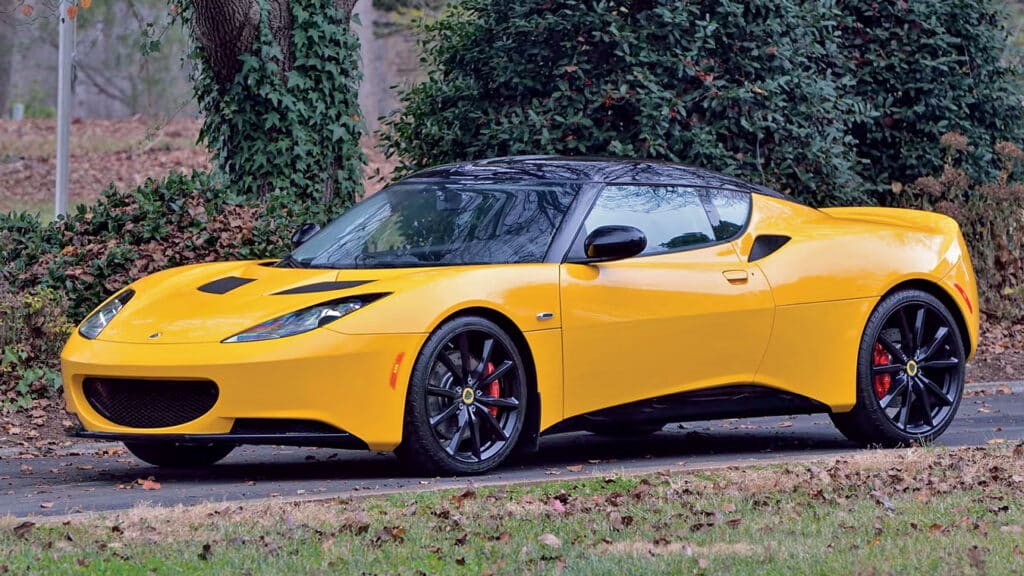
2011 Lotus Evora, sold for $42,323 on Cars & Bids in August 2024. Photo courtesy Cars & Bids.
This 4-seat mid-engine sports car isn’t just rare — it’s a real driver’s car
Imagine being a car designer and being given the brief to produce a sports car that packages both an engine and a pair of rear seats in front of the rear axle but behind the driver. A daunting task, to be sure.
Predictably, there have been relatively few mid-engine 4-seaters that have made it to production. The success of the commuter-friendly Porsche 911 and its vestigial rear seats tempted Ferrari to introduce its 308 GT4 in the mid-1970s. Lamborghini and Maserati also gave this constricted packaging a try in the Urraco and Merak, but neither made it past the initial foray. The Ferrari Mondial arrived in 1980 and lasted the longest, finally bowing out in 1993.
Save for the 911, none of those nameplates have become particularly desirable collector cars. But none are as exotically pretty as the Lotus Evora. Slightly larger and more comfortable than the hedonically minimalistic 4-cylinder Elise and Exige, the Evora managed to tuck both a naturally aspirated 276-hp 3.5-liter Toyota V6 and a rear bench seat into its 101-inch wheelbase. And from the exterior, you’d hardly know it.
Effervescent and entertaining
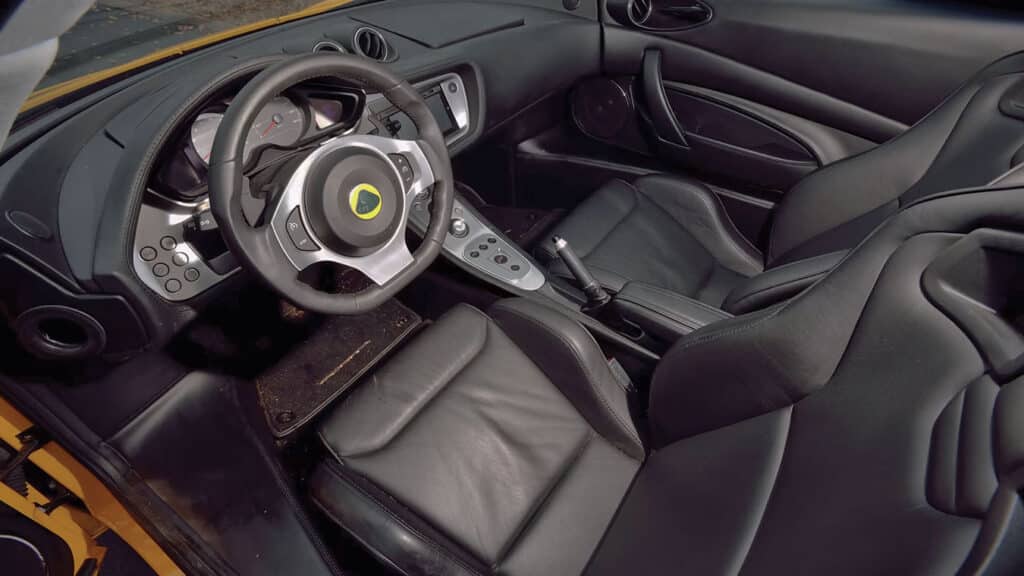
In proper 2000s Lotus fashion, the Evora’s chassis is aluminum, the bodywork is fiberglass composite, the interior is simple (but lined with leather and carpet), and the curb weight is low, at about 3,000 pounds. A 6-speed shifter and three pedals manage power, a nearly useless Alpine stereo/navigation unit like the one your neighbor’s kid had installed at Best Buy suffices for “infotainment,” and nothing can carry your Starbucks order — cupholders weren’t offered.
Lotus’ ode to luxury coupes, this is not. But it was luxury priced. At nearly $75,000 to start, a new Evora cost over $12k more than a comparable Porsche Cayman S, which had over 300 horsepower, far better build quality and more modern conveniences that premium car buyers had come to expect. What the Cayman didn’t have was […]
2011 Lotus Evora, sold for $42,323 on Cars & Bids in August 2024. Photo courtesy Cars & Bids.
This 4-seat mid-engine sports car isn’t just rare — it’s a real driver’s car
Imagine being a car designer and being given the brief to produce a sports car that packages both an engine and a pair of rear seats in front of the rear axle but behind the driver. A daunting task, to be sure.
Predictably, there have been relatively few mid-engine 4-seaters that have made it to production. The success of the commuter-friendly Porsche 911 and its vestigial rear seats tempted Ferrari to introduce its 308 GT4 in the mid-1970s. Lamborghini and Maserati also gave this constricted packaging a try in the Urraco and Merak, but neither made it past the initial foray. The Ferrari Mondial arrived in 1980 and lasted the longest, finally bowing out in 1993.
Save for the 911, none of those nameplates have become particularly desirable collector cars. But none are as exotically pretty as the Lotus Evora. Slightly larger and more comfortable than the hedonically minimalistic 4-cylinder Elise and Exige, the Evora managed to tuck both a naturally aspirated 276-hp 3.5-liter Toyota V6 and a rear bench seat into its 101-inch wheelbase. And from the exterior, you’d hardly know it.
Effervescent and entertaining
In proper 2000s Lotus fashion, the Evora’s chassis is aluminum, the bodywork is fiberglass composite, the interior is simple (but lined with leather and carpet), and the curb weight is low, at about 3,000 pounds. A 6-speed shifter and three pedals manage power, a nearly useless Alpine stereo/navigation unit like the one your neighbor’s kid had installed at Best Buy suffices for “infotainment,” and nothing can carry your Starbucks order — cupholders weren’t offered.
Lotus’ ode to luxury coupes, this is not. But it was luxury priced. At nearly $75,000 to start, a new Evora cost over $12k more than a comparable Porsche Cayman S, which had over 300 horsepower, far better build quality and more modern conveniences that premium car buyers had come to expect. What the Cayman didn’t have was the Evora’s shockingly transparent steering, race-car-firm brake pedal and telepathic driving dynamics. It also didn’t have that rear seat, which many Evora buyers pragmatically passed over for the optional parcel shelf. Most period reviews agreed that while the Porsche was a more impressive all-rounder, the Lotus was the better driver’s car. Its more-focused, elemental experience appealed to hearts over heads, with unmatched rhythm, flow and poise.
In 2011, one year after the Evora hit U.S. showrooms, Lotus silenced detractors who claimed that its Toyota engine wasn’t adequate for a car of this stature. The new Evora S bolted a supercharger to the “Camry motor” for a Cayman S-beating 345 hp. Lotus also opened up the exhaust for a more-sonorous V6 tune.
Also in 2011, no doubt pressured by Porsche’s cutting-edge PDK paddle-shift transmission, Lotus introduced its Intelligent Precision Shift (IPS) gearbox. Unlike Porsche’s 7-speed dual-clutch PDK, IPS was still a 6-speed torque-converter design. Feeling somewhat like a then-antiquated single-clutch automatic, IPS was acceptable for those who refused to row their own gears, but didn’t much resonate with purists.
For 2012, Lotus made some worthwhile changes to the car. An updated interior was more durable and comfortable, and the much-maligned Alpine head unit was swapped for a somewhat improved Pioneer system. The shift cables in manual-transmission cars were redesigned for more-precise action, and Evora S models got black taillight bezels and red brake calipers to further distinguish them from base cars, which now received the S version’s unique suspension wishbones and larger rear anti-roll bar.
More rolling changes and a few special-edition models were introduced through 2014, when Lotus paused its road car sales in the U.S. The brand’s Malaysian owner, Proton, cited U.S. airbag standards as the culprit. Evoras had just a pair of front airbags, and Lotus had been given a temporary exemption due to its low-volume status, but that expired for 2015. Unfortunately, this was the same year that the rest of the world received the revised Evora 400, aptly named for its new 400-hp V6.
2014 Lotus Evora. Photo courtesy Mecum Auctions.
Admission to Lotusland
While Lotus would finally reenter the U.S. market in 2017 with the 400, then the series-ending GT, those two models are still transacting for upwards of $70,000.
Pre-pandemic, prices for the earliest naturally aspirated Evoras bottomed out in the mid-$30k range. But the feeding frenzy of 2020–22 sent values soaring back to a $50k floor. Since then, prices have fallen back somewhat. The new reality is about $40k for early naturally aspirated models, with the supercharged S models closer to $50k.
While the Evora may be a relatively modern car with a proven and reliable powertrain, it wasn’t quite able to shake the Lotus brand’s reputation for being a bit needy. Early 2010–11 cars are often most problematic, with cheaper interior materials and a dashboard prone to warping. Weak clutch master cylinders in early cars can result in dramatically shortened clutch life, so check that both clutch and hydraulics have been changed. Incidentally, a clutch change is an engine-out job that can cost as much as $10k at a dealership.
Additionally, the IPS transmission wiring harness is known to be fragile on pre-2013 examples, causing a litany of electrical issues that require harness replacement to fix. Rear upper control arms on all 2010–14 models are prone to cracks but will hopefully have been replaced by now with a newer OEM part or an aftermarket substitute. The security immobilizer fitted to Evoras can also prove frustrating.
With any Evora (or any Lotus, for that matter), you’ll want to check for a healthy stack of service records and run any candidates through a pre-purchase inspection with a specialist. Compared to more-mainstream sports cars, the Evora is extremely rare, with just over 1,200 units sold over its first five years in the U.S. Find a good one and you’ll be in Evora nirvana.
With an SCM subscription, you’ll have the information, tools, and advice you need from 50+ world-renowned authorities on collector cars to make the best decisions for buying, selling and collecting classic and sports cars.
18 printed issues per year: 12 monthly magazines + 6 special guides
150+ printed pages every month that help you be a smarter collector



Leave a Reply