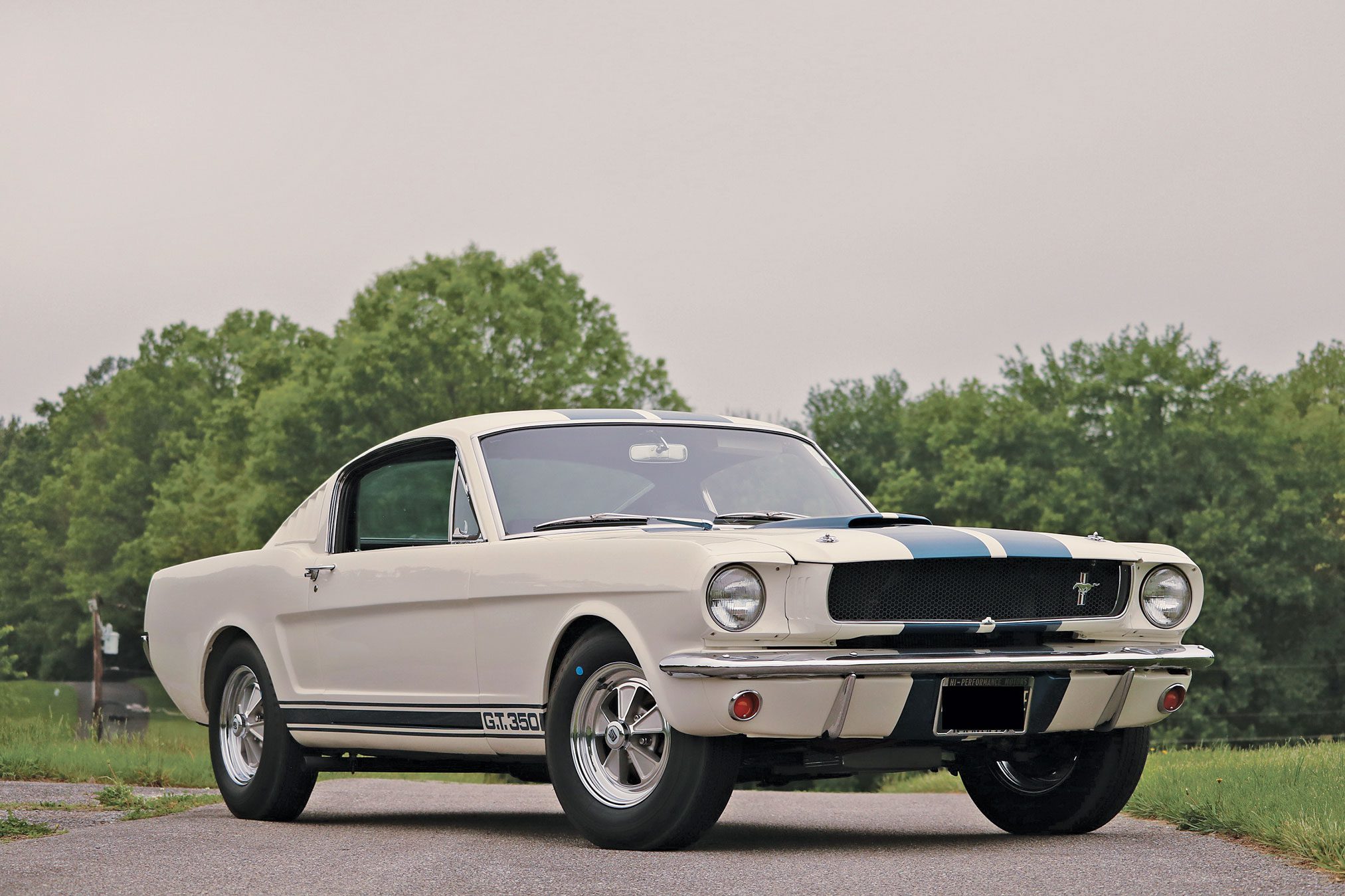
This car, Lot ST0066.1, sold for $702,000, including buyer’s premium, at GAA Classic Cars’ Greensboro, NC, auction on July 26, 2025.
Sometimes we see a car sell for significantly more that anyone would have estimated or imagined. When that happens, we must wonder if there is something really special about that specific car, or did we just have two bidders who had to own it, no matter the cost? In the wake of such a sale, we immediately question if the market has now changed by establishing a new high-water mark, or if the result will have a halo effect on values. Such was the case at Mecum Auctions’ Kissimmee, FL, sale last January, when a 1965 Shelby GT350 sold for $990,000 — a claimed auction-record price. It was a later ’65, but it wore an immaculate restoration and was perhaps one of the most perfect GT350s to come to market.
Fast-forward to July at GAA Classic Cars’ auction in Greensboro, where another 1965 GT350, number 5S033, was offered with a concours-grade restoration. The eyes of the Shelby market were glued to the block that Saturday to see if these first-year Shelbys had established a higher value or if the market would return to pre-January levels. (The SCM Pocket Price Guide lists a high value of $525,000 for a 1965 GT350.) Our subject car was part of the first batch of 110 GT350s completed by Shelby, which does make it more desirable than a later 1965 car, as with the January sale.
Special Shelbys
To understand the significance of these early “first batch” Shelbys, you need to know that Ford wanted to race the Mustang against the Corvette in the SCCA’s B Production class. The standard Mustang would not meet requirements, as it was not considered a sports car. Mostly this was because it had four seats and the SCCA defined a sports car as having only two. Also, the manufacturer had to produce at least 100 examples.
Ford tasked Carroll Shelby with making the Mustang SCCA-compliant, so he decided to delete the rear seats and replace them with a fiberglass package tray where the spare tire would now be mounted. He placed an order with Ford for 110 cars (95 street cars and 15 competition cars). According to the SCCA rules, the street cars had to either share their engine with the race cars or share the same braking and suspension systems. Since a race engine wouldn’t last long in a street-driven car, the easy decision was to put the race-car brakes and suspension on the roadgoing version.
The street engine was modified from the stock Mustang 289 with the addition of a dual-point distributor, aluminum intake manifold, headers, a four-barrel 715-cfm Holley carb, and an aluminum, large-capacity oil pan. These modifications would increase output from 271 hp in the stock Mustang to 306 hp. Shelby also added a side-exit exhaust system with glass-pack mufflers, optional 15-inch alloy wheels, a 16-inch wood steering wheel borrowed from the Cobra (not to be offered on GT350s after the “first-batch” cars were completed), and a new dash pod with tachometer and oil-pressure gauges. Shelby also moved the battery to the trunk for better weight balance (later in the 1965 run, the battery remained in the engine compartment).
At this time, Shelby was still operating out of his Venice, CA, shop, where Cobras were being assembled. With the addition of these Mustangs delivered by Ford, he was running out of room fast and had to expand his operation to two airplane hangars at Los Angeles International Airport (LAX). While all of the 110 cars were delivered by Ford to the Venice shop, only about half were turned into GT350s there; the other half were completed at LAX.
So, if you really want a piece of that special magic that Shelby bottled as the early GT350, you will want a Venice-built “first-batch” car. This is exactly what GAA Classic Cars consigned to its Greensboro sale, making for the first public in-person auction for an early 1965 GT350 since the surprising January result in Florida.
Transcending time
When chassis 5S033 drove onto the block, bidding was fast, and the car quickly reached $600,000, where it appeared to stall. A few interested bidders kept upping the ante when the reserve was lifted at $635,000. Finally, the hammer fell at $650,000, resulting in a final sale price of $702,000 with the buyer’s premium added. While not at the near-million-dollar level of the January car, this result was still significantly above where the market had been in 2024. Perhaps bidders’ January enthusiasm had tapered somewhat, but the sale price still acknowledged the special nature of these cars.
Shelby Mustangs continue to have strong appeal to collectors and are among the few 1960s muscle cars that transcend generational divides in the collector car market. With limited production, smart styling, an enclosed cabin and brisk performance, the GT350 remains a desirable and usable car for vintage rallies and other car events. As seen in Greensboro, these factors will continue to make for a strong market for these cars in the years ahead.